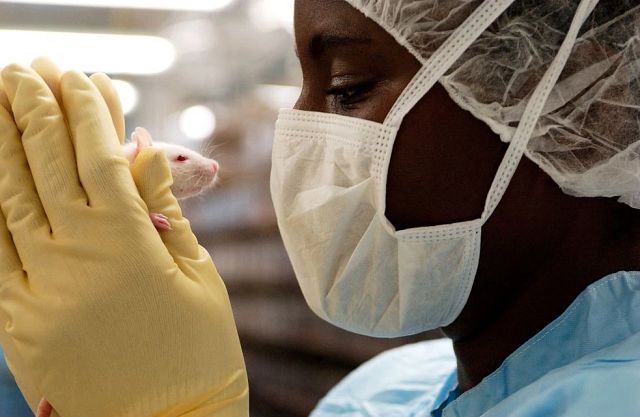
What is Aggression in Mice?
Mice that are aggressive with humans are jumpy, difficult to catch, overly active, and may even bite their handlers. In interactions with each other, aggressive mice will fight, wound, and even kill each other. In the first case these behaviors could be considered defensive or aggressive and indicate a negative human/animal relationship. In the second case, these behaviors indicate an unstable social environment. Both concerns may occur in the same mice, and can be addressed through behavioral management interventions.
What Causes Aggression in Mice?
Human/Mice Interactions
When mice are handled by humans, a likely cause of aggressive mouse behavior is fear. The behavior of an animal during interactions with humans is dependent on its habituation and previous experience with humans, and confidence or trust towards humans has to be developed through positive experiences. To better manage an animal’s fear, habituate it to handling before beginning procedures. In other species, the best habituation results are seen when animals are regularly handled when young.1, 2
Mice/Mice Interactions
Aggression, or agonistic behavior, is defined as behavior directed toward another that elicits an aggressive or defensive response by the recipient.5 Examples include threatening postures, chasing, pinning, mounting and biting.6 Mouse aggression in the laboratory is primarily, though not exclusively, a male problem. Aggression in male mice is a reason why female mice are frequently preferred as test subjects. Female mice can be aggressive toward each other and their mates, but this is usually related to defense of the nest and of pups.7
Understanding the Mouse World
-
Mice in the Wild
In the wild, male mice maintain a dominance hierarchy and patrol territories that they have scent marked. One adult male mouse is the primary breeder in the territory and the others disperse or are subordinate.8 Normal dominance behavior between males in the wild is usually mitigated by escape or appeasement (i.e., submissive behavior from the recipient).
Wild mice do fight and they are injured, but they are rarely killed by other mice, especially after dominance hierarchies are established. In cages, dominance-related behavior can escalate from dominance to injury or killing because there is no way to escape an aggressive mouse. Escape does not necessarily mean traveling great distances; it can be as simple as moving out of the sightline of the dominant animal.
-
Mouse Hierarchies
Dominance hierarchies among mice can be despotic, in which one animal dominates and the others are all equally submissive, or linear, in which there are animals varying in dominance from alpha to omega within one cage. If the dominant mouse is removed, the subordinate mice establish another dominant by fighting amongst themselves.9
An additional complication to working with mice is that the established hierarchies are not apparent to humans. If there are ten mice in a cage, there is a dominant mouse and nine subordinate mice of varying ranks. If the mice are arbitrarily divided into two groups of five by humans, the animals grouped together may be more prone to fighting.
-
Laboratory Mice
Laboratory mice do not have territories to defend in the same fashion as their wild counterparts. Group sizes of five or less have been shown to have fewer agonistic incidents than larger group sizes,15 but the effect of increasing cage size on this group dynamic is unknown. Mice patrol territories that they have scent marked. At cage change, those scent marks are disturbed. As a consequence, post-cage change aggression is seen in mice.
This aggression peaks at 15 minutes post-change16 and lasts at least 45 minutes.17 The greatest level of mouse aggression has been found in cages that undergo incomplete cleaning, such as the renewal of substrate only. Eliminating olfactory familiarity, as is accomplished through a complete cage change and not transferring familiar scented objects, appears to mitigate this aggression.16–18
The only apparent exception to this is that the transfer of nesting material has been shown to mitigate mouse aggression.18 Thus, complete cage change with transfer of nesting material may help diminish post cage cleaning increases in aggression.
-
Aggressive Mice Strains
Some mouse strains are defined by their aggressive nature. Aggressive mouse strains in common use include SJL,10 BALB/c,11 and FVB.12 Other strains have been selectively bred to be more or less aggressive in order to study aggression in mice, such as the SAL (short attack latency) and LAL (long attack latency) strains.
Although some consider C57BL/6 mice to be aggressive, in general they are not when compared to other mouse strains. They may appear to be more aggressive, however, because they are the most commonly used mouse strain in research and thus there are many of them to observe.
GUIDEBOOK
Rodent Model Genetic Quality Control
Managing a genetically engineered rodent colony is challenging. Our guidebook contains sound advice on colony management, genetic monitoring, and embryology techniques required to protect your research. Download Now
Strategies for Mitigating Mouse Aggression
-
Habituation
Although not always practical due to the large numbers in use, mice can be habituated to handling as adults through regular positive interactions with humans.3 If formal habituation programs are not practical, implementing low stress handling can help improve human-animal interactions. Using low-stress handling when picking mice up from their home cage reduces stress, anxiety, fear towards humans, aggression.13 – 21
Low-stress handling refers to using cupped hands or a tunnel to move a mouse, and avoiding lifting mice by the tail. Additionally, to reduce overall stress for mice between handling episodes, provide them with in-cage resources that encourage natural behaviors, such as nesting or burrowing materials.4
-
Structural Modifications
Removing enrichment resources that cause competition can decrease aggression.
In a cage, structural enrichment becomes the predominant feature and the dominant animal may use it as a marking post or a resource to be dominated. Structures that create ambush points, such as tunnels with single point of access or elevated structures from which dominant animals can waylay subordinates entering or exiting can exacerbate aggressive interactions.
The possible exception to this is nesting material, which has been shown to decrease mouse aggression and may also provide more flexible escape routes, mitigating also aggressive interactions.16, 22 – 25 While in general this is our best recommendation, there is at least one report26 of nesting material increasing aggression and shelters decreasing it, thus showing that response to enrichment is specific to genetic background and any intervention should be evaluated on a strain-by-strain basis before widespread implementation.
-
Stabilization of Mouse Groupings
Fighting sorts out the social hierarchy in groups of mice; generally once the social hierarchy has been established, additional fighting should not be necessary.15 Therefore, maintaining males' weanling groups and preserving those familiar social contacts should sustain these stable social groups and decrease fighting.15 While removing the dominant mouse will sometimes be an easy fix, this may also increase fighting among the other animals as a new dominant emerges. Aggression in most strains of mice is exacerbated by solo housing.5 Even separation from a group for 24 hours may induce changes in behavior. Single housing is not ideal, as mice have shown a preference for social conspecifics even in the context of aggression,24, 27 but it may be the final option and (anecdotally) sometimes the only way to manage some strains of aggressive mice after weaning.
Frequently Asked Questions (FAQs) About Reducing Aggression in Mice
-
What does Charles River do to mitigate aggression?
- We preserve the male hierarchical order by maintaining the population within a cage after weaning. Animals are provided enrichment in the form of nesting material in their home cages.
- We divide animals within their transport crates according to home cage and provide additional enrichment during transit.
- We do not ship animals that are displaying dominance behaviors within their origin cage. Aggressors are removed as they are identified.
- We preserve the male hierarchical order by maintaining the population within a cage after weaning. Animals are provided enrichment in the form of nesting material in their home cages.
-
What can I do to mitigate aggression in my facility?
- House animals as received in the transport crates, if possible.
Breaking cages down into smaller groups or recombining animals from multiple cages breaks established hierarchies and may lead to increased fighting as the mice vie for dominance. - Maintain a consistent environment.
Changes in light schedules, temperature, or humidity can affect animal behavior. House animals on lower racks away from lights if possible. Additionally, mice are very sensitive to sound and vibration. Attempt to house animals away from doors, windows, sinks, or other equipment. - Maintain consistent vivarium staff.
And ask personnel to avoid using new scents such as those from cologne, perfume, deodorant, or lotion. - Provide enrichment such as chew sticks or nesting material.
However, avoid huts or tunnels as these may increase aggression. During cage changes, transfer used nesting material from the old cage to the new cage.
Most importantly, we recommend seeking the assistance of your facility's veterinary team, and only single-house animals with approval.
- House animals as received in the transport crates, if possible.
-
What if I notice a sudden increase in aggression?
Consider whether anything in the animals' routine has changed. A new technician, construction nearby, or a faulty piece of equipment could all lead to changes in animal behavior.
-
Should I switch animal models?
You may wish to consider selecting a different model for your studies. Search the literature for other applicable models or contact our technical support team for assistance.
If you choose to try the same mouse from another vendor, it is important to consider the differences between substrains.
For example, there are two main branches of C57BL/6 substrains, C57BL/6N and C57BL/6J, from which many new substrains have been established. A new substrain is created after 20 generations of breeding, separate from an existing colony. Many substrains were generated before the advent of cryopreservation and thorough genetic monitoring programs. As such, there are documented genetic1 and behavioral2 differences among substrains which may be impactful in certain research areas.
Further Examples:
The C57BL/6J substrain carries the Nnt mutation, which affects mitochondrial redox balance—an important aspect of cellular metabolism—and may have a significant impact on metabolic studies.3
C57BL/6N substrains carry the retinal degeneration rd8 mutation in the Crb1 gene, leading to phenotypes that should be considered for ocular research.4
Based on the potential influence of such differences, it is recommended to continue using your current substrain if you are in the middle of a study or course of studies, and to wait for a new set of experiments before making a change.- Simon, Michelle M, et al A comparative phenotypic and genomic analysis of C57BL/6J and C57BL/6N mouse strains. Genome Biol. 2013 Jul 31;14(7):R82. doi: 10.1186/gb-2013-14-7-r82
- Bryant, Camron D, et al Behavioral differences among C57BL/6 substrains: implications for transgenic and knockout studies. J Neurogenet. 2008;22(4):315–331. doi: 10.1080/01677060802357388
- Toye, A. A., et al A genetic and physiological study of impaired glucose homeostasis control in C57BL/6J mice. Diabetologia. 2005 Apr;48(4):675-86. doi: 10.1007/s00125-005-1680-z.
- Mattapallil, Mary J et al, The Rd8 Mutation of the Crb1 Gene Is Present in Vendor Lines of C57BL/6N Mice and Embryonic Stem Cells, and Confounds Ocular Induced Mutant Phenotypes. Invest Ophthalmol Vis Sci. 2012 May 17;53(6):2921-7. doi: 10.1167/iovs.12-9662.
References
-
References
- Clay, A. et al. Habituation and desensitization as methods for reducing fearful behavior in singly housed rhesus macaques. American Journal of Primatology. 71, 30-39 (2009)
- Swennes, A. G. et al. Human handling promotes compliant behavior in adult laboratory rabbits. JAALAS. 50, 41-45 (2011)
- Scott, J. P. & Fredricson, E. The causes of fighting in mice and rats. Physiol Zool. 24, 273-309 (1951)
- Berry, R. J. The natural history of the house mouse. Field Studies. 3, 219-262 (1970)
- Hurst, J. L. & West, R. S. Taming anxiety in laboratory mice. Nat Methods. 7, 825-6 (2010)
- Van Loo, P. L., Van de Weerd, H. A., Van Zutphen, L. F. & Baumans, V. Preference for social contact versus environmental enrichment in male laboratory mice. Lab Anim. 38, 178-88 (2004)
- Miczek, K. A., Maxson, S. C., Fish, E. W. & Faccidomo, S. Aggressive behavioral phenotypes in mice. Behav Brain Res. 125, 167-81 (2001)
- Brown, R. Z. Social behavior, reproduction, and population changes in the house mouse (Mus musculus L.). Ecological Monographs. 23, 217-240 (1953)
- Poole, T. B. & Morgan, H. D. Differences in aggressive behaviour between male mice (Mus musculus L.) in colonies of different sizes. Anim Behav. 21, 788-95 (1973)
- Lumley, L. A. et al. Reduced isolation-induced aggressiveness in mice following NAALADase inhibition. Psychopharmacology (Berl). 171, 375-81 (2004)
- Dow, H. C. et al. Genetic dissection of intermale aggressive behavior in BALB/cJ and A/J mice. Genes Brain Behav. 10, 57-68 (2011)
- Pugh, P. L. et al. A behavioural characterisation of the FVB/N mouse strain. Behav Brain Res. 155, 283-9 (2004)
- Gouveia, K., Hurst, J.L. Improving the practicality of using non-aversive handling methods to reduce background stress and anxiety in laboratory mice. Sci Rep 2019 9:20305
- Clarkson, J.M.; Dwyer, D.M.; Flecknell, P.A.; Leach, M.C.; Rowe, C. Handling method alters the hedonic value of reward in laboratory mice. Sci Rep 2018 8:2448
- Clarkson, J.M.; Leach, M.C.; Flecknell, P.A.; Rowe, C. Negative mood affects the expression of negative but not positive emotions in mice. Proc R Soc B 2020 287:20201636
- Ghosal, S.; Nunley, A.; Mahbod, P.; Lewis, A.G.; Smith, E.P.; Tong, J.; D’Alessio, D.A.; Herman, J.P. Mouse handling limits the impact of stress on metabolic endpoints. Physiol Beh 2015 150:31-37
- Gouveia, K.; Hurst, J.L. Reducing mouse anxiety during handling: effect of experience with handling tunnels. PLoS ONE 2013 8(6)
- Ono, M.; Sasaki, H.; Nagasaki, K.; Torgoe, D.; Ichii, O.; Saski, N.; Agui, T. Does the routine handling affect the phenotype of disease model mice? Jpn J Vet Res 2016 64(4):265-271
- Nakamura, Y.; Suzuki, K. Tunnel use facilitates handling of ICR mice and decreased experimental variation. J Vet Sci 2018 80(6):886-892
- Roughan, J.V.; Sevenoaks, T. Welfare and scientific considerations of tattooing and ear tagging for mouse identification. J Am Assoc Lab Anim Sci 2018 58(2):142-153
- Henderson, L.J.; Dani, B.; Serrano, E.M.N.; Smulders, T.V.; Roughan, J.V. Benefits of tunnel handling persist after repeated restraint, injection, and anaesthesia. Sci Rep 2020 10:14562
- Mertens, S.; Vogt, M.A.; Gass, P.; Palme, R.; Hiebl, B.; Chourbaji, S. Effect of three different forms of handling on the variation of aggression-associated parameters in individually and group-housed male C57BL/6NCrl mice. PLoS ONE 2019 14(4)
- Poole, T. B. & Morgan, H. D. R. Differences in aggressive behaviour between male mice (Mus musculus L.) in colonies of different sizes. Animal Behaviour. 21, 788-795 (1973)
- Van Loo, P. L.P., de Groot, A. C., Van Zutphen, L. F. M. & Baumans, V. Do male mice prefer or avoid each other’s company? Influence of hierarchy, kinship, and familiarity. Journal of Applied Animal Welfare Science. 4, 91-103 (2001)