
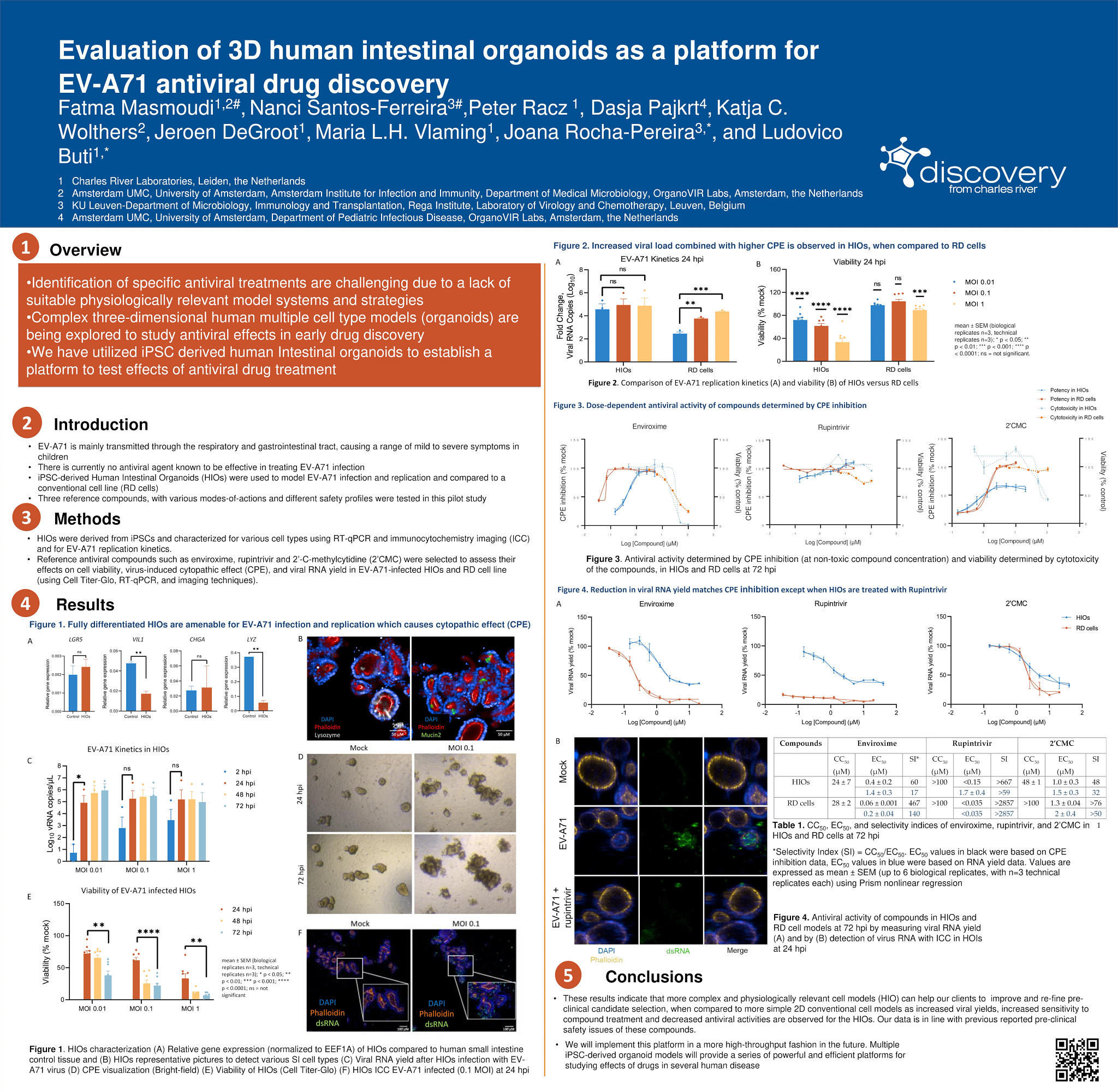
This scientific poster “Development of human iPSC derived small intestinal organoids as a model for EV-A71 infection and antiviral drug treatment” by authors from Charles River, Amsterdam UMC and the KU Leuven-Department of Microbiology, co-first authored by Charles River’s Fatma Masmoudi, discusses the use of iPSC derived human intestinal organoids (HIOs) to establish a platform for testing the effects of antiviral drug treatment.
Development of antiviral treatments for EV-A71, which is mainly transmitted through the respiratory and gastrointestinal track, causing a range of mild to severe symptoms in children, is challenging due to a lack of physiologically relevant model systems and testing strategies. There is currently no known antiviral agent effective in treating EV-A71 infection. In this pilot study, three reference compounds were studied using human intestinal organoids as a testing environment.
Study results strongly indicate that iPSC-derived organoids demonstrate increased viral yields and sensitivity to compound treatment, when compared to simpler 2D models, offering a powerful and efficient platform for preclinical candidate selection and disease-relevant drug-effect studies in Early Discovery. To learn more about how iPSC-derived organoids can support antiviral therapeutic development, please contact us and speak with our high content imaging team.