CBA Mice Details
From a cross of a Bagg albino female and a DBA male by Strong in 1920. The CBA strain was selected for a low mammary tumour incidence. Transferred via The Jackson Laboratory to Haldane and Gruneberg in 1932. To Carter (CBA/Ca) in 1947. VAF/Plus breed stock to Charles River Laboratories UK from Glaxo in 1992.
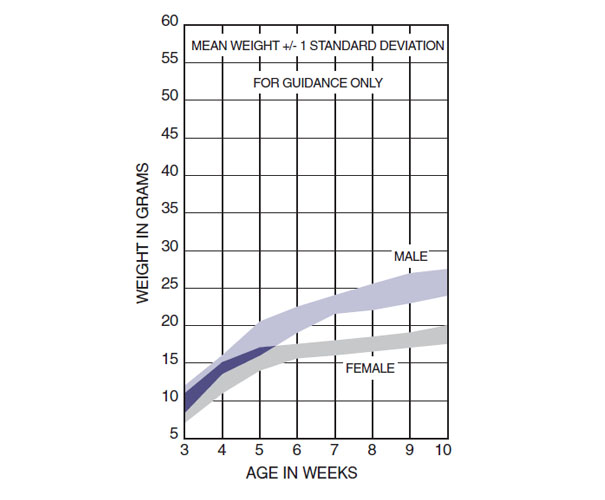
Growth chart data should be used as a guideline only.
The shaded areas on each chart are the mean weight plus or minus one standard deviation at a given age averaged across all production facilities. This represents approximately 67% of the population, with the remaining 33% falling outside of this weight range.
UNIT: A57
Download the Report
➤ DOWNLOAD OUR CATALOG for instant access to Standard List Pricing
➤ TALK TO US to discuss organization or volume-based discounts
Already have an eCommerce portal account?* Login to order research models, obtain quotes, view organization-specific pricing, and see inventory. Processing time required to validate new eCommerce access requests.
*eCommerce is available in US, Canada, UK, France, Germany, Austria, Netherlands, Denmark, Finland, Norway, Sweden, Spain, Portugal, Belgium, Luxembourg, and Switzerland
Try out the CBA mouse with our animal evaluation program
Optimize Your Neuroscience Research Program
From basic research to regulatory approval, we have the translational science, range of services, and collaborative approach you need to discover novel therapies. Learn More


GUIDEBOOK
Rodent Model Genetic Quality Control
Learn the essentials of genetic QC programs: inbred/outbred colony quality control, transgenic rodent model creation, rederivation, and cryopreservation techniques. Download Now
Frequently Asked Questions
-
What are CBA mice, and why are they used in research?
CBA mice are a strain of laboratory mice commonly used because they have a stable genetic background and are suitable for a wide range of medical and biological studies. CBA mice have been extensively studied and are well-characterized, making them ideal for use in experiments where consistent and predictable results are important.
-
What are the advantages of using CBA mice in research?
One of the primary advantages of using CBA mice is their genetic homogeneity, which means that they have a consistent and well-defined genetic background. This makes them ideal for use in studies where it is important to control for genetic variability. Additionally, CBA mice are relatively uniform in their physiological responses, making them good candidates for studies examining drug efficacy and toxicity.
-
Are there any limitations to using CBA mice in research?
While CBA mice are widely used in research, there are some limitations to their use. One limitation is that they may not accurately represent human physiology in all cases, so caution should be exercised in generalizing findings from these mice to human health. CBA mice, like all animal models, have limitations in their predictive power. The results of experiments conducted in mice may not necessarily translate directly to humans.