
Perspective
|
Deborah Dormady Letham, PhD
Fruitful Learning from a Next-Gen Sequencing Sabbatical
Or how I made connections between the data-driven world of science and shards of glass in a garden clean-up
Just this spring, I checked a big item off my bucket list and took a sabbatical for professional development. To paraphrase one of my favorite rock artists, Tom Petty, I've been "Runnin' Down a Dream”— for years. Being able to step away from the computer emails and meetings, and into the lab—where any seasoned scientist dreams to go— I was able to ease back to the days when I started my career with “regular” bench work.
As a molecular biologist I trained on now “classic” science techniques of DNA and RNA manipulation, so this four-week sabbatical opportunity to sequence a pool of known viruses in a mock sample (which I previewed in my previous blog Next Generation Sequencing) came at the perfect time. It allowed me to put my lab skills and brain power to work in new and exciting way.
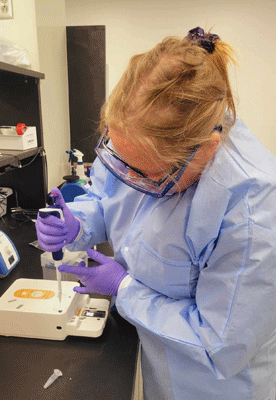
An unintended side effect of my work is that I also began to view items in the outside world like recently sequenced specimens ready to be catalogued. Who knew you could make connections between the data-driven world of Next-Gen technologies and some random pieces of glass tossed in an overgrown garden. Let me explain – it is all about the cataloging and the data dig.
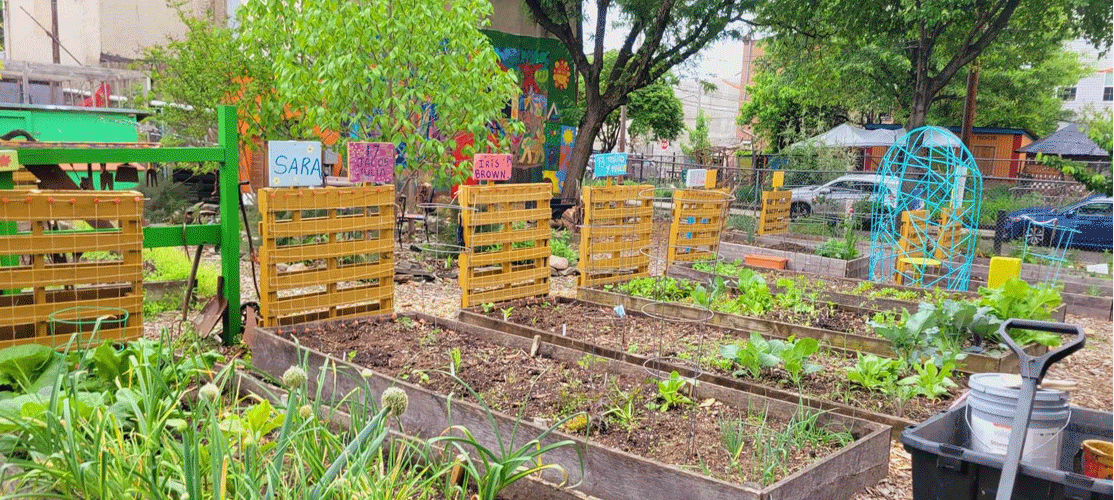
No sooner had I wrapped up my sabbatical, than a couple of volunteer time-off opportunities grabbed my attention. The first was with a community garden in Philadelphia’s West Kensington neighborhood (shown in main image). This was a multi-site event that brought my Charles River coworkers together from Quality Assurance, Manufacturing, Molecular, Mycoplasma, and Materials Receiving departments. We spent the day helping the Norris Square Neighborhood Project Community Garden’s resident “Dreamer,” Ms. Iris, a determined woman who watched her mother and grandmother and women of the community make a difference in the everyday lives of their neighbors. This work inspired her family as well, including her daughter and granddaughter (a Charles River employee).
Like I did with my science sabbatical, I lived “in the moment.” I came dressed for serious tasks: thick gloves, garden hat, hair scrunchie, kneeling foam and pruners. I was ready to recapture a jungle. But to my delight and surprise, this inner-city sanctuary garden wasn’t a jungle at all, but meticulously cultivated and set up for inspiring new dreamers. It contained stations for learning and arts-and-crafts and offered tours for young school children on field trips. The garden contained recreated houses and huts commonly found in Puerto Rico and Africa, and colorful murals illustrating the hopes of children who came to the garden to learn in addition to the women pioneers who obtained and created the space.
There were even butterflies being painted, 100 in all, to celebrate the 50th anniversary of the community origins. Ms. Iris took the time to teach us history, the merging of Spanish and African cultures in Puerto Rico, and the determination of its people to find a place to call home after centuries of previous enslavement. She told us how gardening of the land sustained the people and connected their lives to each other. With the food, the materials, and the skills, these people survived and thrived. These are the inspirational stories the neighborhood garden hopes to instill in today’s youth.
Our dreamer was so happy to teach us and was very pleased that we all came without preconceived notions of what our “jobs” would be that day. Some of us painted new fences a colorful green, some spread mulch, some painted boards for future projects, some created butterflies. As for me, I embraced garden weeding.
A Deep Dive Data Dig
But as I set about recapturing the over-wintered veggie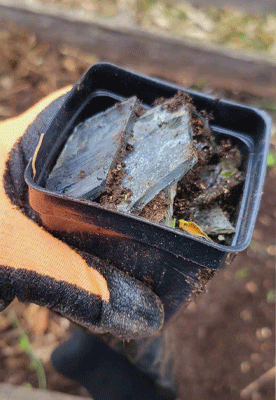 garden beds, I noticed something was out of place. Not one but dozens, probably a hundred pieces of glass were scattered inside the soil. Oh dear! This garden bed was right next to the fence, and a stone’s throw from city streets. I realized that city life must have invaded this section of turf. So, with my sturdy gloves, and careful shovel as a makeshift sieve, I found my “weeding” became intensified, focused and “deep”. My thoughts turned to my sabbatical and my scientific mind quickly correlated the diversity of the types of glass and weeds and critters to the cataloging aspect of Next Generational Sequencing which I had just learned. I began thinking of how to “sort” the finds. For glass it might be the five types I found: clear, white, green, brown, and clear with blue streaks. For garden critters it would be grubs and worms and beetles. For plants (and whatnot) it would be baby tree seedlings, desired perennials, some composted stems and leaves, and a whole diverse set of weed species.
If I had to characterize, in sequencing terms, the method for looking and cataloging this garden bed, I would call it an “agnostic” non-targeted compilation of everything possible that could be identified. I didn’t choose to identify everything on this day, but I could have using all the right diagnostic tools and my memory. At another volunteer event a week later, I found myself sorting SpaghettiOs, cereal bars and tissues at a women’s shelter and food bank. From there I moved to sorting clothing. This became something we would call “targeted” cataloging (another Next Generation Sequencing term) for winter coats and gear. My partners, Rachael and Kristin, and I scoured the piles for boy’s winter coats sized 5/6 and 7/8. These “targeted” non-agnostic cataloging events by the whole crew surely will help them in the winter months, and it cleaned up the room nice too. We knew what we were looking for, then we counted and bagged them. The team then moved on to mittens and hats, but I moved outside again to sort recycling, breaking down boxes from the food bank, another job that is also important in lab maintenance.
It is awesome to help dreamers in any walk of life. Whether we make areas an oasis for art, culture, flowers and veggies, sort items at a shelter, or go back to the lab to learn, we are all trying to improve the world and ourselves, even if it is just a little. We can dream and we can work the dreams, too. If I counted anything during my sabbatical or at those precious volunteer events, it was counting my blessings!