

Microbial Solutions
|
Thomas Grothues, PhD
Horseshoe Crab Habitats Extend Further out to Sea Than We Think
Their coastal spawning habits are well-documented, but little is known about their ecology while at sea
Horseshoe crabs are familiar to visitors of estuarine beaches of Mid-Atlantic states. From May to July, while they are spawning, they spend a lot of time in water only a few feet deep, and even crawl out onto the wet sand to lay and fertilize eggs. It is tempting to think of them as creatures of the shallow bay. In reality, their habitat extends much further than that, and they may spend years at sea before coming into bays to spawn.
Yet, very little is known about their ecology while out at sea. A 2022 review on threats to horseshoe crabs was focused on the inshore life history phase, and this is warranted since reproduction is clearly a bottleneck to population sustainability. However, horseshoe crabs are captured well out to sea in state and federal government fisheries stock assessment surveys and commercial trawlers, which use large drag nets called otter trawls that skim along the bottom (Figure 1). Scallop fishers also catch them in their steel-framed, chain clad drag nets (called dredges), and ocean-going clam fishers suck them up with elephant trunk-like contraptions that shoot water into the sea-bed and turn it into a slurry for pumping onboard.
The horseshoe crabs generally survive all of these approaches intact because of their armor. While studying fish bycatch on these vessels, I once caught a freshly molted horseshoe crab. It was mustard yellow and textured like a foam (Nerf) football, soft but fibrous feeling, and had rolled up on itself. Horseshoe crabs must escape their own shells to grow, since the shells do not grow with them. Hours after splitting their shell and crawling out, they swell quickly to a new size by absorbing lots of water and then secrete a new shell to grow into. They must be very good to eat for ocean predators during this soft stage, especially for small sharks and rays that can’t swallow them whole and need to bite them into pieces. After a number of molts they reach full size and stop molting. It is only at this stage, called terminal molt, that females become egg laying. They probably live several years at this stage and can spawn multiple years. Since they don’t shed their shells anymore, they may collect a number of hitchhikers, like slipper snails and barnacles.
How do seasons influence horseshoe crab distribution?
A simple plot of catch distribution from the Northeast Fisheries Science Center trawl survey from fall (Figure 2) and spring (Figure 3) 2007-2019 shows the seasonality of offshore horseshoe crab distribution. They are more abundant in fall overall and centered closer to shore. This might be the dispersal of crabs that participated in estuarine spawning, but there are many other good reasons to be in nearshore coastal waters in fall. It is warm on the bottom. Some are still captured as far out as the edge of the continental shelf however, which is as far as the survey goes. Maybe the crabs go even further offshore. It is interesting that they are sparse at the center of the continental shelf. This is where a pool of very cold winter water is slowly flowing from north of Cape Cod. In Spring, the center of distribution is shifted further offshore, and again to the edge of the continental shelf with some of the denser catches, as many as 12 crabs in a 2 km-long tow, occurring there. Many of these probably don’t participate in spawning that year. The ones that do may have to travel a ways. A curious behavior that could help was observed in a large aquarium at the NOAA James Howard lab ; horseshoe crabs flipped over on their back and swam around the tank flapping their book gills like paddles.
Presumably, the carapace shape, upside down like a boat hull, provides good lift yielding an efficient swimming form to help get the crabs where they are going a little faster than crawling.
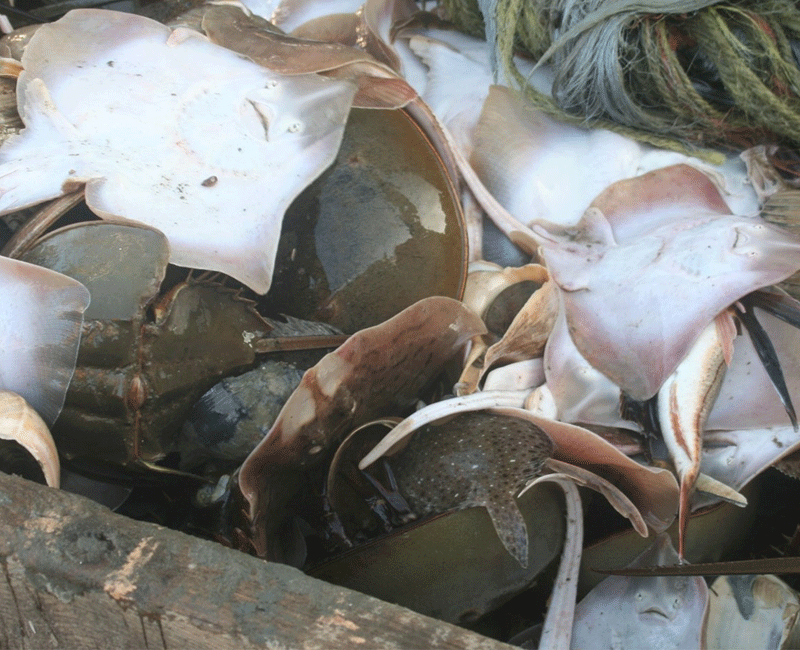
Figure 1. Four horseshoe crabs mixed in a catch of skates and flounder from a commercial trawl catch about 12 miles off the New Jersey Coast. Image Credit: Rutgers university marine Field Station.
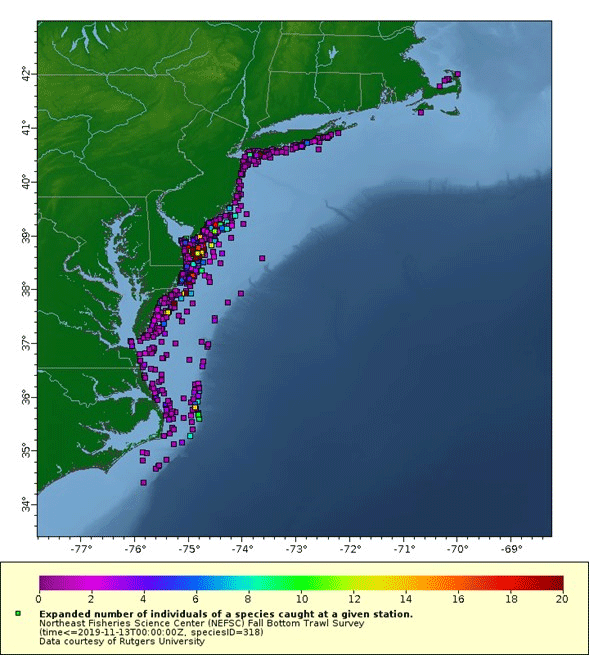
Figure 2. Distribution of horseshoe crabs from Fall trawl samples. Warmer colors indicate more horseshoe crabs in a given tow. Samples that did not catch any crabs are not shown, but are distributed evenly across the continental shelf (light blue in base map).
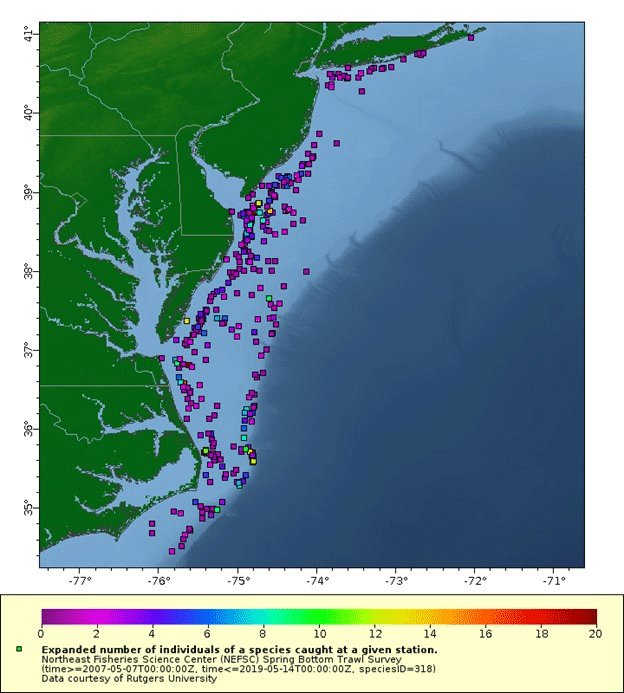
Figure 3. Distribution of horseshoe crabs from Spring trawl samples. Warmer colors indicate more horseshoe crabs in a given tow. Samples that did not catch any crabs are not shown, but are distributed evenly across the continental shelf (light blue in base map).
Thomas Grothues, PhD, is an Associate Research Professor with the Department of Marine and Coastal Sciences at Rutgers University in New Jersey, where he studies the distribution and abundance of marine life. He is also one of the professors leading a project of the Rutgers Aquaculture Innovation Center to rebuild the horseshoe crab population in their area.