
Cell & Gene Therapy
|
Daniel Klein
How Internships are Driving Careers in Cell and Gene Therapy
At Charles River's Memphis site, partnerships with high schools and colleges are helping fill the labor gap in cell and gene therapy manufacturing
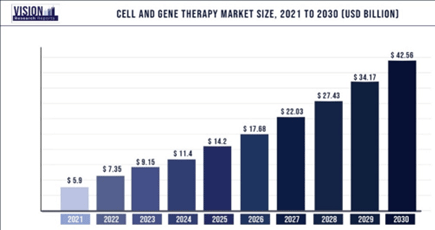
The field of Cell and Gene Therapy is growing at an extraordinary rate. And while only a handful of treatments are currently on the market, thousands of products are in the drug development pipeline and the industry is at the cusp of explosive growth, as the image below shows.
 But with growth comes growing pains. The manufacturing capabilities are nowhere close to meeting this future demand and, more critically, the trained workforce necessary to handle a radically expanded manufacturing capability does not exist. While there is labor shortfall throughout cell and gene therapy drug development, the disparity between the number of technicians currently working in cell and gene therapy manufacturing and the number required over the next decade is enormous.
A recent survey published last year in Nature Biotechnology found that the number of CAR-T job postings by the three top drug developers more than doubled between 2019 and 2020, despite the ongoing COVID-19 pandemic. Most were for technical positions. The recent ARM Workforce Report estimates the industry could employ 32,000 people just in manufacturing and R&D positions by 2025. With the shortage so acute, companies are needing to get creative. And what is beneficial in one area might cause problems in another.
In 2021, Charles River Laboratories acquired Cognate BioServices, a cell and gene therapy contract development and manufacturing organization. Their headquarters of Memphis, Tennessee came with significant logistical advantages. “The type of work we do, the types of products that we make here are critically dependent on very crisp logistics,” explains Site Director Will Isom, adding that the location was chosen due to its proximity to the FedEx Global Super Hub. As the work is based on fresh human blood and tissues with stringent timing limitations, “we're dependent on the ability to get [our client’s] product basically anywhere in the world within a matter of hours.”
The problem is, Isom explains, “Memphis is not exactly Boston… which presents a challenge when it comes to workforce development and attracting talent. It’s tougher for us… because the candidate pool is so much smaller.” Without a dedicated feeder system for talent, there’d be no hope at all. “We needed to catch a lot of these people when they were still in school,” says Isom, as training for biomanufacturing technicians takes upwards of six months.
A cell and gene therapy training program takes off
Charles River Memphis’s solution was an internship program. “We wanted to make sure that this was a very intentional program,” says Isom, “not just being gophers, people around to take out the trash and do that type of work. We really wanted them to get involved in the operation.” It started out slow and carefully: “We had challenges with them even knowing this industry existed,” says Molly Field, Charles River Memphis’s manufacturing supervisor, now turned university and community relations manager. Initially partnering with the biotech and forensic science department of one of the local community colleges, just three interns were brought on the first semester.
The program has been very successful and has grown significantly since it began in 2021. “I had fourteen this [2023 spring] semester, targeting for twenty in the fall,” says Field. “Each one has a project that is going to teach them the industry and leave a positive impact.” It’s been a boon to the students as well, with over 80% of them accepting a position. “We wanted to make sure that we were able to devote the type of bandwidth necessary for a good experience. We didn't want to leave them out there just dangling with no support and no attention,” says Field. The effort has paid off, with potentially surprising downstream benefits: “Our program has had the investment from our local colleges because of word of mouth. They tell all their friends, ‘this is the internship you want’.”
But perhaps more importantly, it’s changing the framework. “A lot of universities, they say that in order to be in a patient-impact position, you have to go to medical school and be a doctor or a nurse,” says Field. The reality, of course, is that many jobs in the research and manufacturing of new drugs and therapies don’t need a doctorate. The local schools are also getting involved in a more direct way. “We've been able to advise on useful skills and techniques, what will better prepare their students,” says Isom. There’s also a lot of excitement on the educational side, working towards integrating the need for practice in sterile environments in their laboratory curricula. Everyone benefits, the students are more prepared, and the applicant pool expands.
The Memphis site’s involvement with the community doesn’t end at education. “We’re a ‘chairman circle investor’ in the Greater Memphis Chamber,” says Isom. “Now that some of the local leaders know what they have here in town, there's a very big focus from them on attracting more companies like us to the area and to the region, trying to drive more investment on the part of the life sciences.” The students themselves also get involved, with a significant portion of their internship devoted to a self-directed community project. “I've worked for companies before that say, ‘Oh, yeah, we care about the community.’ But then either don't do anything at all. Or when they do, it feels very superficial,” says Field. “It’s been a really rewarding experience… [students have said] that this is something they really appreciated the opportunity to do.”
The Memphis team believes their success at addressing the labor gap is replicable and are moving towards helping other sites establish similar programs. “This is not Memphis unique,” says Field, “it is something that can be customized for every site.” Overall, says Isom, Memphis has been extremely pleased with the outcome. “We think it helps with turnover, retention. When we're capturing these people younger like this… it just makes for a stronger, more comfortable employee.”


