
Biologics
|
Deborah Dormady Letham, PhD
From the Lab: How Sanger Sequencing Changed Biologics Testing
From a first-generation tool to an elaborate automated system that sequences DNA in a matter of minutes
At Charles River I often refer to myself as our “Grandmother of Sequencing,” not because I invented the technique or envisioned the outsized impact it would have on our Biologics business, but because I stepped in and owned the set-up process for it at our site over 20 years ago.
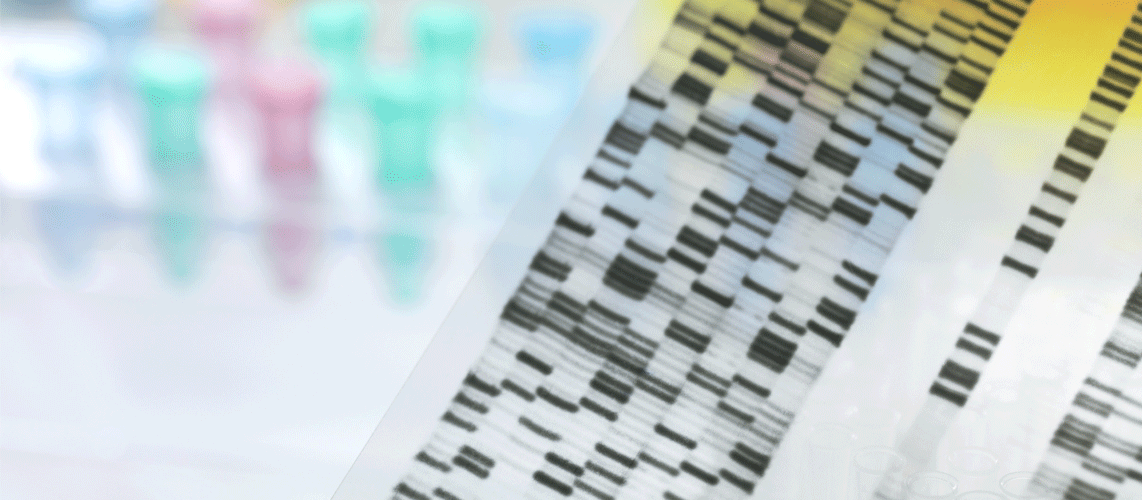
I got my first taste of manual Sanger sequencing in 1991, when I was a graduate student at Cornell University. By then, Frederik Sanger’s method, enabling labs to determine the order of nucleotides in a sample of DNA, had both been widely adopted as the industry standard and been needed to submit newly discovered genes to the electronic databases (yes, the Internet had just barely been invented). Later it was automated and commercialized by research groups and companies, but it was still very much a first-generation tool back then. I remember having to manually pour the thin polymerized gel between two glass plates about three feet long, sealed with yellow thin electrical tape, and add a shark’s-tooth comb to create wells for loading radioactive sequencing reactions. Because of the high voltage, we were always hoping it (or we) didn’t catch fire in the process! Sparks, Sparks, Sparks!
Capillary-based electrophoresis instruments
It wasn’t until 2002, when I joined Charles River’s Methods Development department in Malvern, PA, that I got the chance to assemble (and tear apart) one of these automated and now capillary-based electrophoresis instruments. No more pouring, no more fires. In truth I could not have done this without our trusty Field Service Engineer, Bernie, for whom I still have his number in my cell. I needed to use Sanger sequencing to verify the recombinant DNA plasmid construct I had put together by cloning a gene region into a backbone of a transfer vector.
The sequencing instrument that I needed to confirm the construct, a single capillary 310 Genetic Analyzer, was brand new and not in service yet, so I took ownership of the process, and got it running. Not only did this help me a lot it also helped my colleagues and clients. An automated system still had its bugs to work out, bubbles in the lines, current issues in the runs. And, oh, that delicate method to change a capillary and replenish the polymer in a glass syringe was so tedious it all made me a bit superstitious.
And yes, I would still recommend to this day (even just in fun) the method of tapping your plate of reactions on a metal surface for five taps (or increments of five), and of course pray the runs of 2-3 hours for each injections ran OK. Like I said, I was superstitious for good reasons!
DNA sequencing of recombinant constructs
Since those days, we have stepped up to more elaborate systems (less superstition and more system) for now our fourth improved model of instrumentation since that 310), and now we have a whole team to work on them as well. So, I stepped to the side and back to designing new PCR assays in our Methods Development department to improve techniques for the safety testing of pharmaceuticals produced in biological substrates. Then very recently I found myself donning my “grandmother hat” and deciding to keep a close eye on a special project for verifying recombinant constructs by DNA sequencing within our qualification group.
It was a really busy time of the year with a lot of demands on their/our time, but the project needed that special touch and attention. The particular recombinant constructs being worked on are the producers of certain heavy chain and light chain immunotherapy medications used quite successfully to fight different cancers. I knew from the client information that the construct was for a much-needed anti-cancer medication, one that could give real hope to patients.
So, while the team did the painstaking work of setting up the experiments as well as newer instruments, I watched from a distance, like a grandmother, to make sure the work went smoothly. I was glad to be able to give just a little guidance to the workers and I was gratified to be on hand, when needed, to teach the new technicians some of the history of DNA sequencing, and how we perform the work today. But it is even better to watch the process and projects thrive without you, to be able to step away and see that everything still runs OK.
Imagine, one instrument and one capillary was already an improvement to my manual method days, now they use even more automated systems with streamlined workflows—and leave me in the dust - and that is OK. I owned the process but did not hold onto it. It’s like letting a kid take off the training wheels and just go. Yes, we should all be pleased to let others bring their own skills and own these new methods now. (I did however purchase the team’s celebratory ice cream once it was finished, such a fun Grandma job to own!)
DNA sequencing as an industry now includes super exciting new tools, such as whole genome sequencing, single cell sequencing, and my favorite term: deep dive sequencing for unknown detection of mixtures of sequences. But classic Sanger Sequencing is still the tried-and-true confirmatory technique helping us help our clients. We in the DNA Sequencing world can continue to work on supporting these cancer treatments, one base at a time.