Perspective
|
Deborah Dormady Letham, PhD
My Adventures in Daily Science: An Origin Story
Or how a childhood filled with hissing cockroaches, cow digestion and a side business collecting fireflies fed a lifelong curiosity about the natural world
I recently heard Bill Nye, the Science Guy recount his amazing, door-opening experiences of being a student at Cornell University. I couldn’t help nodding along in agreement. I too have a degree from this prestigious institution, and I can relate to how Cornell changes lives in marvelous ways by giving us opportunities at our fingertips.
For me, the magic of Cornell started long before my hard-earned graduate degree in molecular biology. I grew up in Ithaca, home to Cornell and the heart of the beautiful NY Finger Lakes. My mom worked as an administrative assistant at the Veterinary School’s Physiology department, so as a budding scientist I was more than happy to tag along with her. As a kid, with opportunities abounding, it was perfectly normal for me to become immersed in science that was literally at my fingertips, and occasionally up to my elbows – as when, during many open houses at the Cornell Vet School, I got to put my hand and arm into the fistulated cow with three stomachs. This process allows research veterinarians (and curious 10-year-olds) to understand cow digestion better. Cool Cows!
My fascination didn’t end there. When I was a preteen in the 1980’s I continued to have adventures in daily science life. I took walks in the woods on my family’s farm with my grandparents and aunts, looking for wild strawberries, monarch butterfly caterpillars, and grasshoppers. I especially remember a stretch of summer evenings collecting fireflies for the world-famous “Father of Chemical Engineering” Professor Tom Eisner. He gave us a nickel for every firefly (which we used to buy ice cream) so that he could study both the chemicals which allow the fireflies to glow and to study how female fireflies keep their egg masses from being devoured by predators like birds, which actually learned to avoid fireflies.
I recently re-listened to a podcast episode with Tom Eisner describing his bug and bird experiments and how it led to his firefly work, not only to learn about fireflies in general but to learn how these discoveries might help human medicine. Fireflies have a natural substance that tastes terrible to birds, and Dr. Eisner and his colleagues discovered that this was acquired by female fireflies by “faking out” the light flash to attract certain other male fireflies and devouring the males (hoping to mate), then depositing these chemicals into their eggs for protection. Wow!
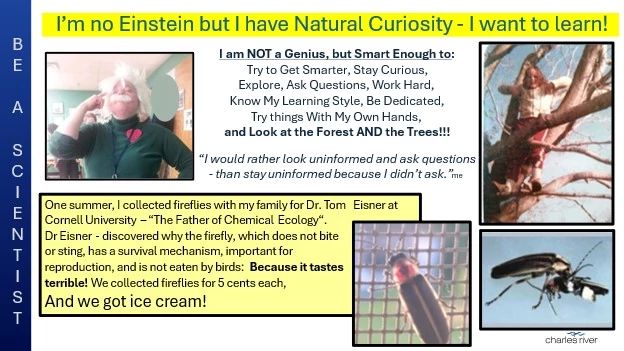
Hissing cockroaches and PBJ in trees
My memory can still tune into Dr. Eisner’s words with the ears of that 10-year-old girl looking to make a nickel, but as a seasoned scientist I can also listen and appreciate how scientists are opportunists and observational folks. Yes, my science curiosity is a memory that is still as vivid as the sound of some hissing cockroaches that I also remember seeing in his lab, or vivid like studying the moving clouds out on the farm. When I give a presentation on how I got to be a scientist, I like to include a photo of me up in a tree where I ate many PBJ lunches on our walks from the backyard to the field by the pond (where we also collected tadpoles each spring). I am living proof that it is always fun to learn and to reach new heights in science and in trees.
Bill Nye, class of ’77, spoke about how he got “hooked” on being a scientist by being exposed to cool science – and crucially about his becoming a science educator, someone who connects with the general population for the benefit of science education. Bill spoke about how even our American Founding Fathers recognized the importance of science by spelling out in the US Constitution (Article 1 section 8) how Congress has the power to “promote the Progress of Science and useful Arts”. Science is still vital to our prosperity and exciting in our lives, no matter what age. Science educators, like me, find that in addition to loving the science, we love the people too; all people are naturally curious about science. When we tap into their curiosity, we can help them dream about the “what ifs” – about what we could do – how it could help – and how things work.
Be a scientist! Make memories and sometimes impromptu slime
Yes, all children are curious, yet in the teenage years many leave their science curiosity behind because it seems “uncool” or “icky”. Well, STEM – or “STEAM”— (Science, Technology, Engineering, Arts, and Math) programs in schools and in communities are vital to not only each child’s enrichment but to our progress as a nation and a population globally. We need the STEAM to keep the engines turning in all walks of life. There are many STEM or STEAM possibilities that we could be championing. Even if we have done an experiment many times, it is going to be new to the new student testing the parameters and principles.
A favorite STEM teaching memory from my Cornell Graduate School days was volunteering with “Expanding Your Horizons” for teen girls. At these sessions we discussed DNA technology and ran agarose gel electrophoresis for DNA samples, pretending we found some at a crime scene; the girls had to match the unknown to known patterns. At the end of one particular session, I had one of those miraculous moments when I realized my teaching had made a difference. A young girl, around 6th or 7th grade, demonstrated to her father what I demonstrated to her class: how to use the giant photographic imager, a UV transilluminator with a Polaroid camera. I was amazed at how quickly she learned and explained what she learned, and wow Dad was impressed, too! That STEM lesson GREW quickly.
Here is another memory: ever make slime? We make it all the time in Girl Scouts with white glue, a little water and a little borax laundry reagent. STEM possibilities show up at the kitchen table all the time in my house. Once when a Girl Scout mom and her daughter were coming to pick up cookies from me, a.k.a. the cookie mom, they said they didn't have a 5th grade science fair project.
So, I pulled down the slime-making borax and glue and food coloring and we did a science project right there for the interested kid and tired mom. A little squish squish, and snapshots on the phone and they had instant poster material. It is not just the slime that sticks, it is remembering the curiosity, knowing the achievements, having the learning and of course stretching the fun in life (longer than the slime).
So, let’s keep the fun in the learning and learning in the fun. And be grateful for these memories that power that engine of science, no matter where you are!