

Discovery
|
Hazel Paulo, MSc
The Tale of the Goopies!
How our lab at Charles River built a service to expand on drug permeation testing capabilities
My little but growing group (In Vitro Innovations, EDI site) is an interesting team which has grown out of standard services provided in CRL Edinburgh. This blog is the tale of ‘the Goopies’…
Firstly, some background about my group. We are a discovery/bespoke testing team who create studies to further investigate a client’s material. We carry out both GLP and non-GLP studies based on our client’s needs but there are no OECD guidelines for us to comply with. As an In Vitro group, every study we run contributes to the 3 R’s (Reduce, Refine, Replace) by providing clients with information about their products without the use of animals. We have two main branches: In Vitro Toxicity assessment using 3D cell models with a strong focus on inhalation toxicity and ex vivo drug permeability (which I have affectionately termed ‘the Goopies!’). The tissues used in ex vivo permeability studies come from either tissue banks or abattoirs as a by-product of the food industry and handling of them is completely different and a lot messier compared to the sterile cell culture models used in the other studies run in our team – hence the name ‘the Goopies’.
Shortly after I joined the company in 2015, myself and a colleague took on the running of the OECD 437 Bovine corneal opacity and permeability (BCOP) assay. At this stage we were a little team of three. We ran this as a commercial service for around three years alongside other OECD guideline in vitro toxicology studies. Also in our study repertoire were dermal penetration studies (OECD428) which CRL Edinburgh has been running during their development and OECD acceptance for around 30 years and have remained at the forefront in this field.
Cornea permeation: Eureka!
In 2018, things began to take unexpected twists and turns. Early in the year, after recently becoming a study director in the team, a couple of enquiries came in - one looking to investigate drug permeation across the vaginal epithelium and the other to investigate drug permeation across the cornea. The strategy for the vaginal epithelium study was an initial no brainer; use the standard skin permeation equipment! But the cornea permeation was a true lightbulb moment! Hang on... bovine corneal opacity and permeability assay, the specialised equipment for this sort of thing was right under our noses!
Designing the vaginal permeation study was an interesting and challenging experience, involving a lot of questionable google searches into the characteristics and dimensions of vaginal tissue (sorry IT!!), some bizarre conversations with clients, tissue banks, abattoirs and my colleagues and manager. One morning in particular sticks in my mind – While car sharing with my manager, he brought up the topic of acquiring vaginal tissues to which I replied, ‘It’s 8.40 am, can the vagina chat please wait until after 9?!’. It’s probably not a shock to you that I regularly found myself thinking…’this is not where I thought my career would go’. With each answered question or decision made it felt like another five arose! Trying to design a functional, logistically possible, and physiologically relevant study was no easy task and of course there is only so close to the real human environment that we can ever make an ex vivo model. That said, the resulting study was a success and the client even returned for a second study!
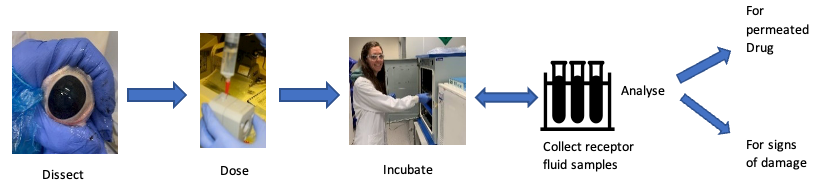
Figure 1:Typical flow of a cornea permeability study design
Designing the cornea permeability study was a multi-person effort, but at least this time the questions didn’t get us many funny looks. We also were able to combine some of the toxicity elements of the original BCOP study into the design, which provided an indicator of whether or not the test item was causing damage to the cornea and leading to increased permeation. Soon enough we were regularly being asked about cornea permeability and in 2020/2021 we completed a series of studies for a client to aid in formulation optimisation before they progressed to further clinical investigation.
Since these first two enquiries ‘the Goopies’ has really taken off as a concept, bizarre conversations with colleagues and abattoirs have become the norm and the list of tissues we have designed studies for is ever expanding:
- Vaginal
- Ocular – Cornea and Sclera
- Intestinal
- Buccal and sublingual
- Nasal
- Mucosal
- Placental
We have also drafted in other in-house experts – bioanalysis for in house sample analysis and formulation development to offer formulation preparation and optimisation. This has the potential to provide a valuable service to clients to help them take their drug product to a prepared formulation ready for efficacy and further safety testing!
All in all, I’m delighted with how the Goopies empire has grown and I’m proud that we are continuing to find new ways to contribute towards the 3R’s principles every day!
Hazel Paulo, MSc, is a Study Director at Charles River Laboratories, Edinburgh