
Cell & Gene Therapy
|
Marie Ojiambo, B.Pharm, M.Sc.
What’s Hot in 2024: CRISPR Treatments
The world’s first therapy utilizing CRISPR/Cas9 gene editing technology is OK’ed for sickle cell patients. What’s next?
In recent days, both the UK and the US approved a cell-based therapy for the treatment of sickle cell disease in patients 12 years of age and older with recurrent vaso-occlusive crises.
Not only is this a major step forward in the treatment of this blood disorder, but it also opens the door to treatments for other diseases employing the gene editing tool.
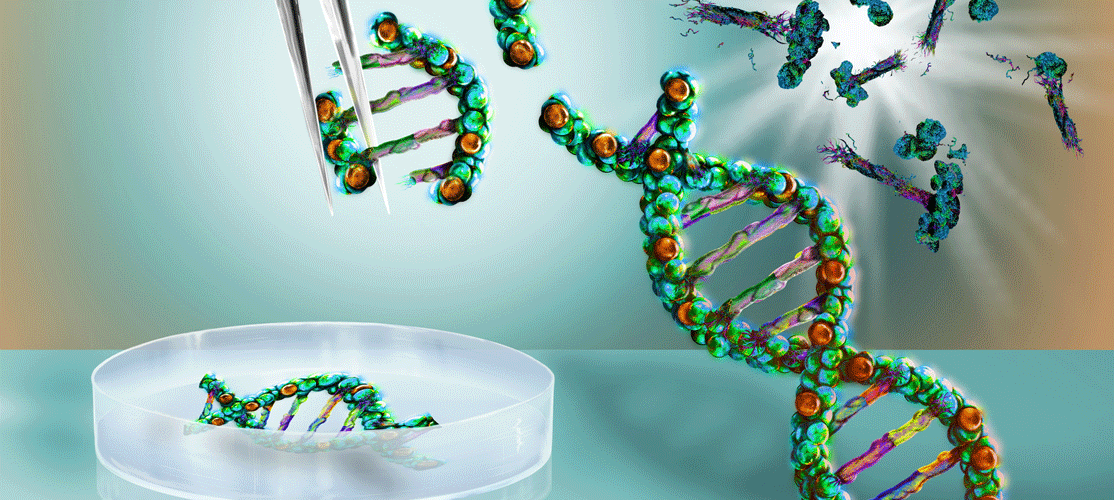
CRISPR-CAS9 is a cutting-edge medical technology used for genome editing. This therapeutic approach works by changing the DNA sequence in a cell.
CRISPR which stands for Clustered Regularly Interspaced Palindromic Repeats was first used in 2012 by Jennifer Doudna (UC-California Berkeley) and Emmanuelle Charpentier (Max Planck Institute for Infection Biology). These scientists used an enzyme known as Cas 9 (CRISPR associated protein 9), a nuclease to cut double stranded DNA in bacteria.
It was then successfully used in 2013 in genome editing in human cell cultures. The Cas9 protein is like a knife that acts as molecular scissors to cut DNA while a single guide RNA (sgRNA) acts as a chaperon to Cas9 to tell it where to cut the DNA.
Today researchers worldwide apply the method to edit the DNA sequences of plants, animals, and laboratory cell lines, but until now it had never been used as a treatment in disease.
Sickle cell disease (SCD) is a genetic disorder caused by a mutation in both copies of a person's HBB gene which encodes for a component of hemoglobin, the oxygen-carrying protein in red blood cells. The mutation is a point mutation in the hemoglobin beta gene (HBB) found on chromosome 11. This mutation causes hemoglobin molecules to lose their round, fluffy confirmation and stick together, creating sickle-shaped red blood cells. These sickled red blood cells restrict the flow in blood vessels and limit oxygen delivery to the body’s tissues, leading to severe pain and organ damage called vaso-occlusive events (VOEs) or vaso-occlusive crises (VOCs). The recurrence of these events or crises can lead to life-threatening disabilities and/or early death.
Fetal hemoglobin (HbF), the main oxygen carrier in the fetus, is the major genetic modulator of the hematologic and clinical features of sickle cell disease. HbF genes are genetically regulated, and its production is ‘switched off’ shortly after birth. The levels of HbF and its distribution in sickle red cells is highly variable across individuals with the disease. High HbF is associated with milder but not asymptomatic disease. To protect against various complications of sickle cell disease, different concentrations of HbF have been postulated to be required, although any increment in HbF has a beneficial effect on morbidity and mortality. Higher HbF levels are associated with a reduced rate of acute painful episodes, fewer leg ulcers, less osteonecrosis, less frequent acute chest syndromes, and reduced disease severity.
CRISPR/Cas9 can be directed to cut DNA in targeted areas, enabling the ability to accurately edit (remove, add, or replace) DNA where it was cut. The modified blood stem cells are transplanted back into the patient where they engraft (attach and multiply) within the bone marrow and increase the production of HbF.
The CRISPR therapeutic Casgevy, developed by Vertex Pharmaceuticals and CRISPR Therapeutics is designed to induce production of fetal hemoglobin. It does so by disrupting expression of a gene that represses transcription of the gene encoding γ-globin, which forms the tetrameric protein along with α-globin. With Casgevy, fetal hemoglobin expression surges, but the amounts in red blood cells are still variable. In this treatment regimen, patients need to undergo blood transfusions for two months before cell mobilization and then two rounds of mobilization and apheresis. (In β-thalassemia, in contrast, no pre-treatment transfusions are needed, and a single round of mobilization and apheresis usually suffices.) To make room for the edited cells, patients also need to undergo busulfan-based myeloablative preconditioning, which is highly toxic.
The arrival of this revolutionary gene therapeutic comes as a breath of fresh air to the sickle cell community. It may not make any real difference to a number of patients who live in countries where this therapeutic is not available, but it does present hope for the future as regards the sickle cell pipeline and research opportunities.
Marie Ojiambo is a Senior Scientific Associate at Charles River Laboratories. She is also a patient living with sickle cell disease.