Discovery
|
Dan Rocca, PhD
Cancer Research in 3D
How in vitro models are helping to crack the problem of poor translation dogging cancer drug developers
Oncology research and modelling of cancer in vitro has come a long way since the establishment in 1951 of the first human cancer cell line HeLa, derived from cervical cancer cells taken from patient Henrietta Lacks. She did not survive her disease, but her cells, remarkable because of their ability to double every 20-24 hours, lived on.
Twenty years later, the first multicell spheroids were generated signalling the beginning of a new era in cancer research. Since then, more complex, three-dimensional models have been developed to better mimic and interrogate cellular interactions within the tumour microenvironment. While 2D in vitro cell culture systems have been the cornerstone of biological research, 3D systems, such as organ-on-a-chip, are becoming a fundamental part of drug discovery programs. Gaining a deeper understanding of how therapeutics perform in these more sophisticated tumour models will undoubtedly improve the success rate of cancer drugs in clinical trials and in the market.
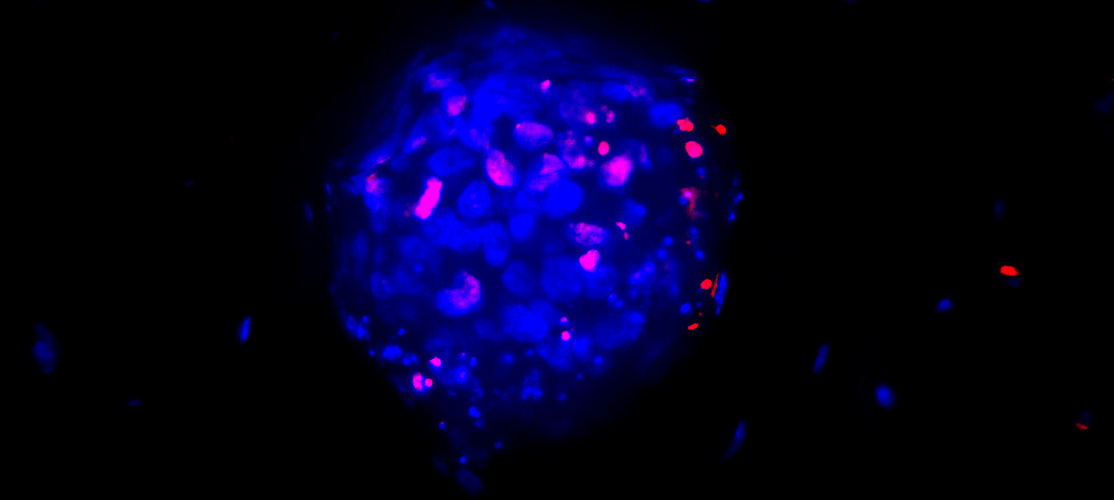
One of the key characteristics of 3D tumour models is that they faithfully mimic the multicellular architecture typically seen in tumours. As a result, many features that underpin tumorigenesis are recapitulated, including genetic heterogeneity, complex extracellular matrix interactions, stratified oxygen levels, distinct regions of proliferating and quiescent/senescent cells as well as drug resistance. Crucially, a recent study comparing 2D and 3D models of colorectal cancer gave strikingly different drug response profiles- when measuring tumour cell proliferation and gene expression - after chemotherapeutic treatment. Charles River offers a wide and customisable range of 3D tumour models. From tumour patient derived (PDX) tumour colonies, through to organoids or spheroids co-cultured with fibroblasts and immune cells, the offering is ever evolving and expanding (see Table 1). In collaboration with Cypre, a 3D tumour platform consisting of up to 42 PDX derived cell lines has been developed that can be readily harnessed to assess therapeutic efficacy. The proprietary hydrogel patterning technology enables consistent, high throughput drug screening capability and robustly models complex biology such as T cell infiltration across stromal layers of a tumour. These HTS-amenable models are great for investigating immuno-oncology targeted therapeutics due to the ease of incorporating immune cells in a well-validated 3D-environment and suit early drug development screening cascades.
In the partnership with CELLphenomics, an extensive library of validated patient derived tumour organoids and PDX lines underpin a powerful precision medicine platform that can be used for drug combination screening, toxicity profiling, target validation and correlating drug sensitivity to clinical responses. The extensive genomic characterization of the donor tissue enables interrogation of genotype-phenotype relationships that impact therapeutic efficacy and resistance in tumours. The human-predictive platform is best suited for understanding therapeutic anti-tumour potency at the ‘hit-to-lead’ or lead stage of development, especially when direct cytotoxicity measurements and interrogation of complex mechanisms of actions are required.
An alternate, cost-effective 3D model approach centres on tumour colonies grown in soft agar - known as a clonogenic assay. The library of > 550 PDX lines is fully validated and provides a platform for early drug screening campaigns. Clonogenic studies are ideal for identifying hit small molecules that negatively impact tumour growth and are not suited to larger molecules such as biologics where immune involvement may be necessary.
The same PDX library and more than 200 additional tumour cell lines can also be used in proof-of-concept modulation of T cell tumour spheroid killing. The models support research into many varied modalities such as IO and oncology targeted therapies, cytotoxic agents, large molecules or cell and gene therapies.
Ultimately, any of these translationally relevant approaches can be harnessed to better assess therapeutic efficacy and/or mechanism of action where key tumour characteristics—such as genetic heterogeneity, immune infiltration, and influence of stromal compartments for example—can be much more readily modelled than simpler 2D systems. However, each system retains unique characteristics which make them uniquely applicable to manipulation of certain pathways and mechanisms.