
Researcher Profiles
|
Regina Kelder
From Childhood Coding to an Expanding Career in Computer Engineering
Patty O’Callaghan’s role as a full-stack engineer reflects the evolving complexity of web development, one that could soon include AI
When she was growing up in Venezuela during the 1980s, Patty O’Callaghan was fascinated with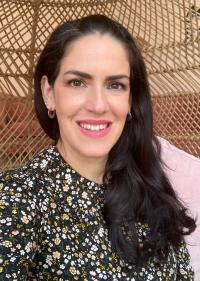 robots and artificial intelligence. She credits her father and Isaac Asimov for this. Patty’s father read a lot of science fiction, and before long Patty was hooked as well, counting Asimov’s stories among her favorites in her sci-fi bookshelf. Born with an engineer’s brain, Patty was also fascinated with computers and how they functioned.
Today, Patty is what is known as a full-stack engineer for Charles River Laboratories. Her role reflects the complexity of web development—which has evolved from text-heavy, basic HTML programming to graphics, visual elements, streaming tools, and interactive design. Lately she is focused on machine learning tools that are allowing companies to work faster and more efficiently.
In 2022, Patty presented at the NodeConf EU on TensorFlow.js. The Node meeting was held in Ireland, not far from Patty’s current home in Glasgow, Scotland. The Eureka blog caught up with Patty earlier this week to talk about her job, the workshop, what it is like to be in a computer engineer in a largely male profession, and what can be done to bring more girls and women into the fields of computer engineering and AI. The article has been edited for space and clarity.
Eureka: What does a full-stack engineer do?
Patty: It used to be that a software engineer handled all areas of a website’s demands, but the amount of data, user traffic, and functional complexity expected of today’s systems far exceeds those of the past. The need for more in-depth skills and specific understanding became obvious. So the profession, by necessity, has divided into three main branches, each with their own niches. You have the back-end developers and devops engineers who take care of everything behind the face of the website, from programming the logic of the application, maintaining databases and services to keeping the site secure. Then you have front-end developers who create the client-side part of websites and applications using web languages and makes sure sites can be seen on a device, like a cell phone or laptop and that the users can interact with it properly. Some highly skilled software engineers are able to work across multiple branches, and they are known as full-stack engineers.
Eureka: How are you applying these skills at Charles River?
Patty: I am the tech lead of the criver.com team. We work with the public facing website. This includes providing online services to our clients, from the forms they use to request the animal models they need for their studies to requests for consults to the Contact Us pop up for online inquiries. We show the Eureka blog and the podcasts and offer resources like webinars and white papers. All this requires us to be able to navigate the different technologies required to stream a video, connect to a third-party system that tracks our customers’ journey, etc.
Eureka: You mentioned earlier your deep interest in AI. How much intersection do you see between web development and machine learning?
Patty: When I went to university in Venezuela I studied AI, but back then the focus was very academic. The commercial implementations of artificial intelligence were not that popular. So, I began my professional career in web development. But today, artificial intelligence commercial applications are booming. We have technologies, like the one I’m going to talk about at the Node conference, that combine artificial intelligence and web development. This is a perfect combination for me because it integrates my passion in AI and my professional career in computer engineering doing web development.
Eureka: Let’s talk about your workshop at NodeEU. What is TensorFlow and why did you choose this as your workshop topic?
Patty: So TensorFlow is the world’s most used library for machine learning. It was developed by Google to help create machine learning models. I do a lot of work with it as a side hobby since I’m an ambassador with Google’s Women Techmakers program. TensorFlow is an open-source platform so there is a huge community around the world who can contribute to it. TensorFlow helps us do machine learning and predictive analysis and a whole lot of things around deep learning as well. I’m going to focus specifically on a library for TensorFlow that can create and deploy models in JavaScript, a programming language mainly used for the web. Our audience will be mostly JavaScript developers.
Eureka: How new is the platform?
Patty: TensorFlow was launched by Google in 2015 and TensorFlow.js in 2018.
Eureka: Why is it important for Charles River to be represented at the Node conference?
Patty: CXE (Customer Experience Engineering) heavily uses Node.js in the development of cutting-edge solutions for CRL and its customers, and as such our presence at events such as NodeConf.eu allow us to showcase some of the work we are doing, as well as to interact with potential future Charles River team members. In addition, it helps us remain an active participant in the wider Node.js ecosystem and gives us an idea of where the tech is heading, so we can remain at the top of our game.
Eureka: So, it sounds like you began figuring out computers at an early age. Who taught you?
Patty: I was lucky. I had access to computers very early on when I was a child, so I started coding by myself with the help of a beginner’s programming book. Also, my auntie had a computer academy. They had opened some computer programming courses for kids, which was very unusual back then. I think I was around eight or 10 years old, and I loved it since then. I just knew then that I wanted to be a computer engineer.
Eureka: Are there many women in leadership roles in your profession?
Patty: I have been working in the industry for more than 20 years, and there are very few times when I have worked with another woman in my team, let alone two women. I’m talking about computer programmers or software engineers. Women are even less prominent in leadership roles, because to have leaders you must bring females into the teams so they can grow their careers in computer engineering into more leadership roles. It’s not easy being a female in this profession. You must work a little bit harder sometimes to make your voice heard.
Eureka: But you are doing your part to try and change this trajectory, right?
Patty: That’s right. I work as a volunteer for an organization called Code Club, part of the Raspberry Pi Foundation. I teach kids from 12-15 years old. When I got there the first day, I saw 20 kids – but only five were girls. So, I was like, OK, what I’m seeing here is the same thing I am seeing in the industry. And by the end of the year, I still have 15 boys but maybe two girls. I try hard to motivate them and some of them to go on to competitions that are just for girls.
Some people might think women avoid this field because they aren’t treated right in technical teams. I don’t necessarily believe that. I’m not saying that hasn’t been the case for many women, but for me I have always felt very respected and well-treated wherever I worked. So, I think this lack of interest among girls is more of a cultural thing.
Eureka: Thanks for your time, Patty. I just have one more question and it’s a fun one. Who is your favorite AI character?
Patty: HAL 9000 -- the computer in 2001: A Space Odyssey. It’s a kind of evil computer, but I absolutely loved it and the movie.
Eureka: Yes, a great choice. Good luck at the workshop.