
Discovery
|
Mary Parker
How Digital Twins are Transforming Medicine
AI-assisted human disease computer models may speed up drug development
What if you could test a drug candidate on people before clinical trials? What if, instead of mice, a human computer model could be the first “lab rat” to determine the efficacy of a molecule, or to provide insight into a potential drug target?
What if you had the next best thing: a digital human model of disease developed with the help of artificial intelligence. This model would not only mimic generic human responses to potential drugs but could also be programmed to mimic the response of specific patient groups, specific tumors, and specific diseases.
Thanks to a partnership with AI biotech company Aitia, Charles River has access to these potentially invaluable alternative models. Under the terms of the agreement, Aitia will deploy Logica™ —a customized turnkey drug discovery solution launched in 2022 that integrates world-leading laboratory capabilities with best-in-class AI-driven molecular design—across their portfolio of novel drug targets with the aim of creating and advancing drug candidates for neurological indications, including Alzheimer’s, Parkinson’s, and Huntington’s diseases and cancers, including prostate cancer and multiple myeloma. Additionally, Charles River and Aitia have signed a strategic partnership agreement, focused on the development of a patient-derived xenograft (PDX) Digital Twin to predict the best tumor models for in vivo oncology research. The first phase of the project will focus on lung, pancreatic and colon cancer.
Ensure Your Program is RACE Act-Compliant
This webinar will address the problems of outstanding clinical trials for pediatric cancer drug development and provide alternatives for IND programs, highlighting pediatric PDX model collection.
Watch the webinar
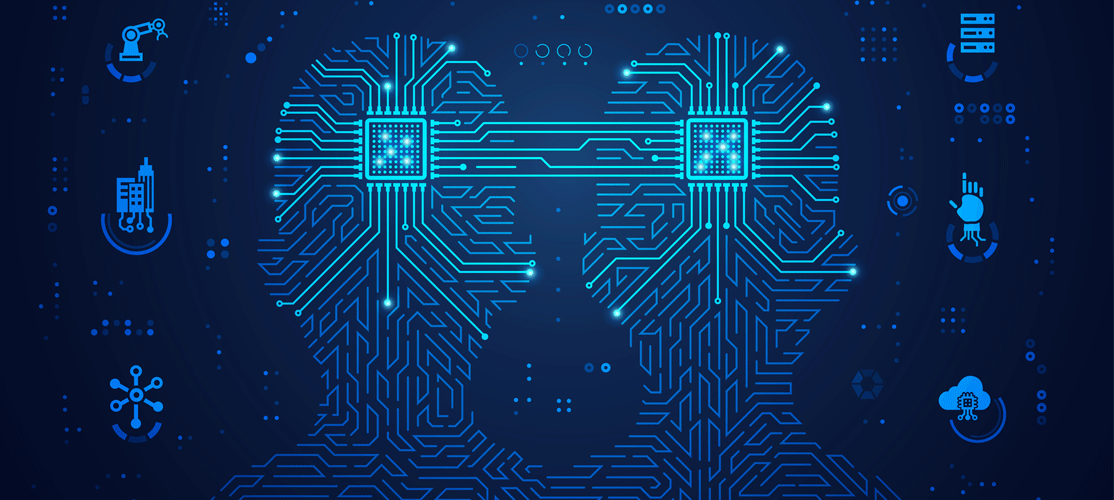
What Are Digital Twins?
“Gemini Digital Twins are computer replicas of human biology that connects demographics to genetic variation to the molecular variables that drive clinical outcomes,” said Colin Hill, Chief Executive Officer and Co-Founder of Aitia.
According to Colin, even after tens of thousands of papers and 80 years of biomedical and drug research, we only understand about 5% of molecular circuitry in human biology. This is one of the issues at the heart of why drug development is so expensive and uncertain, with many candidates making it through several testing rounds before they are discovered to be failures.
“Digital Twins are straight from human multi-omic* and clinical data,” he said. “They're reconstructing that circuitry – recreating the known 5%, which is a useful positive control for us, and then filling in the hidden 95%, which is a real game changer.”
Are Digital Twins Better Than Traditional Research Models?
Digital twins offer researchers the chance to model diseases, seek out drug targets, and find disease biomarkers in the closest approximation to humans available. Using these systems early in the process can help separate promising candidates from potential failures earlier, only sending the most auspicious molecules through to the next round.
Traditional models are still required at many stages of the drug development process. However, digital twins could help in that arena as well.
“We do use preclinical systems to add more evidence into the biology of the discoveries,” Colin said. “Part of the partnership between CRL and Aitia involves creating Gemini Digital Twins of PDX mice (mice with human tumors inserted into them). Lots of animals are typically used in traditional drug screening, so if now one can create accurate digital twins and prescreen before animals are used, you can cut down on the use of animals.”
Digital Twins and Neurodegenerative Diseases
Digital twins are not only valuable for drug development. A poster published by Aitia last October shows the potential for digital twins to be used to validate more accessible methods for testing patients for the amyloid Alzheimer’s biomarker.
Traditionally, in order to test for Alzheimer’s, patients are injected with a radioactive diagnostic agent and sent for a PET scan to look for the buildup of amyloid beta plaques that is characteristic of Alzheimer’s.
Although this test is not invasive, PET scans are expensive. In many cases a physician would only order such a test if they were already pretty sure of the results, which would mean the patient’s disease would have progressed to a very noticeable point. Since most proposed Alzheimer’s treatments work best when administered as early as possible, this leaves a significant time gap between onset of disease and testing for confirmation.
The poster presents the results from Alzheimer’s Digital Twins derived from the GAP (Global Alzheimer’s Platform) Bio-Hermes study, the largest AD trial of its kind evaluating biomarkers, surrogate markers, and cognitive tests and prioritizing diversity in the study protocol. Specifically, Aitia Gemini Digital Twins have yielded new levels of predictive accuracy of PET positivity across different ethnoracial groups as well as various disease stages. These models may result in a cost-effective and convenient approach to address the high screen failure rate in clinical trial recruitment that currently plagues Alzheimer’s clinical trials. Moreover, Gemini Digital Twins showed that they can maintain equivalent predictive performance with other blood biomarkers even in the absence of p-tau 217 and can allow utilization of easily accessible and self-reported data in a cost-effective screening approach.
Browse our Cancer Model Database
Support your in vitro, in vivo, and ex vivo studies with a user-friendly search, new model data (including HLA typing, growth curves, and tumor images), and multi-parameter search options for all tumor models (PDX and CDX) and cell lines.
Visit our database
Digital Twins Going Forward
Extrapolating the unknown from the known is the greatest strength of AI, but that strength is based on AI’s greatest weakness: it is at the mercy of the data it is fed.
“I think we need to collect deeper and richer data from humans,” said Colin. “We've gotten very far in being able to extract signal from data, and even if there's missing data, we have developed ways of imputing values. But to really unravel the molecular underpinnings of disease, someone will have to generate data like that.”
This is especially the case in an industry where ~90% of drugs fail at some point in the process, leading to losses that are compensated for with higher drug prices. Whittling away at that 90%, getting promising drugs pushed through while abandoning failures earlier, will benefit both the industry and patients.
“I think the low hanging scientific fruits have been plucked,” said Colin. “We have no choice but to tackle the true complexity of human disease by any means necessary, and I think Charles River has a huge role to play in bringing the whole arsenal of preclinical and animal systems to play to use in concert with computer models of human systems.”
“I think we're at the beginning of a new era of where there's a chance to really unravel the complexity of human disease, and that will fundamentally change how new drugs are discovered.”
*multi-omic data is defined as data sets that comprise DNA sequence variation (whole exome or whole genome) or targeted sequencing, gene expression and/or proteomics, and quantitative clinical outcomes and labs.