Perspective
|
Deborah Dormady Letham, PhD
Scientists, Start Your Engines!
What and who is driving science innovation? And how will we know when to adopt it?
When I read a newsletter informing me that the European Pharmacopoeia Commission would be providing a new guidance for the adoption of High Throughput Sequencing (HTS) to study viral contaminant detection in biological products, then saw the release of the WHO Expert Committee report on Biological Standardization, plus saw a CAACB conference advertised on NGS strategies for adventitious agent detection, I knew that the regulations were now finally catching up to the science. These new guidances recommend how to study biologic-derived pharmaceuticals, and the science now includes establishing HTS (also known as Next-Generation Sequencing or NGS) as a regulatory-accepted alternative to both in vivo and in vitro viral safety assays. Acceptance, adoption, and adaptation benefit from aligning methods, which is the aim of the International Council for Harmonisation. For the benefit of researchers and regulatory authorities, the guidance's detail technical requirements for verifying pharmaceuticals for human use, in particular the ICH Q5A(R2) guidance supported by the US Food and Drug Administration and European Medicines Agency. They also offer the motivation for continued innovation to modify and optimize the molecular-based methods that scientists use to ensure the safety of our medications and their starting materials.
Scrolling through the training materials based upon the ICH Q5(R2A), and attending many talks about using NGS recently, reminds me of my own NGS sabbatical project and how I used that experience as my vehicle for change, not just in the science realm and how we look at regulations, but in how I try to encourage folks to further their education. Learning never stops and can be self-driven. The innovations we have in science serve as enrichment. I know my own existence as a science educator is inspired by knowing that we as an industry are more likely to adopt innovations if we understand them.
With humor, I would like to consider myself as “Miss Frizzle” from the fictional TV series “Magic School Bus”. That is, I am having tickled fun learning the science, “Take chances, make mistakes, get messy," which includes driving to explore innovations and interesting learning opportunities. Put another way, I feel like I am continuously driving a bus full of curious scientists like me. "Seatbelts, everyone!" After I recently travelled to another Charles River site to give a motivational talk about continual learning, a friend said, ‘You are getting a lot of mileage out of that 4-week sabbatical.’ “Well, yes, I am,” I said.
So, please allow me to relate how the release of these new and current guidance, which relate to how we look for adventitious agents like viruses in pharmaceuticals, connects to the larger theme on my mind of the importance of building new roads and then driving on them. We in science are not just tasked with creating the vehicles, engines (and repairs), and the fuel to propel them forward; we are charting out the whole map. Jump on a tour bus of interested scientists traveling the gamut of scientific innovation.
Well-travelled paths may have helped us get from “point A to point B” in science exploration (or in driving), but picture if you will, a new avenue or thruway being created, or a bridge spanning rough terrain. Travel might definitely be faster and certainly would be more direct, but the end result doesn’t begin to reflect what it took to get there. When creating a new road, there are many stages of construction, from laying down the road base and paving it to curing the concrete or macadam. At some point, the road is drivable, but if lane markings haven’t been added, it might not be feasible or safe to venture out. And we can’t forget adding exit signs and rest stops… So important for “go-no-go” testing points for our brakes, too. What about creating those “AAA TripTik maps” of old, which offer helpful suggestions on where to stop during a long journey? They will need to be printed, and the modern-day navigator, like Google Maps, will need to reflect the new road(s) in order for us to get to our destination. If you take this analogy and apply it to the lab, scientifically speaking, the science may have been in place, but it’s the guidance of the industry that is needed to advise what roads to take to reach the desired destination.
As scientists, we, of course, like to embrace new technology, but we must remember our end goal, our scientific purpose. Like one of my early mentors, Dr Charlie Uhl at Cornell University, for whom I wrote a blog recently, we must see and use our science as tools to work on a problem or puzzle, not just look at how the tools themselves operate as science. We should all be more interested in the “why” than the “how”, and the “ultimate goal” must still be defined and pursued, even if the tools have been changed.
Building new roads of molecular methods
As for my, 20 years at Charles River, we have been building new roads, working on sensitive DNA and RNA characterization experimental tools like PCR (Polymerase Chain Reaction) for detection of adventitious agents (viruses and such) not desired in the vaccines and other products, such as recombinant antibody therapies, similar to the ones my own family members have taken as treatments. We search for undesired adventitious agents as contaminants that may be introduced in the raw materials or in the production process. Molecular assays are sensitive and useful in finding those “needles in the haystack” that can sully a biological product. Our department, along with our team of qualification, validation, and routine-work scientists, has helped to bring in the tools for the characterization of our clients’ “biologics” drug treatments. The recombinant DNA technology used to create these new biologics, as well as the raw materials or starting cell lines for therapeutic production, has been tested and verified. These treatments must meet safety criteria. In other words, we need to keep our instruments and methods up to current standards and not miss the bumps in the road that could compromise patient safety.
Along the way in science, we are repaving the old roads and building those new roads of technological advances to get to our destination more efficiently. We connect our tried-and-true tools, which are still viable, to new avenues and vehicles. In keeping with the current guidance, we make inroads with new technology, and we run the vehicles side by side to compare speed and efficiency.
Deep sequencing NGS HTS systems are not new, but are now being used to help us get us more efficiently down the road. And doesn’t everyone enjoy a new road? This is why a classically-trained molecular biologist like myself decided to explore this during my sabbatical last year; I wanted to learn new tools, and learn how to drive the tour bus for showing off these new technologies. I am a firm believer in the adage that “if you are the smartest person in the room, then you are in the wrong room”. I therefore dove into the learning opportunities.
Doing my NGS sabbatical the old-school way
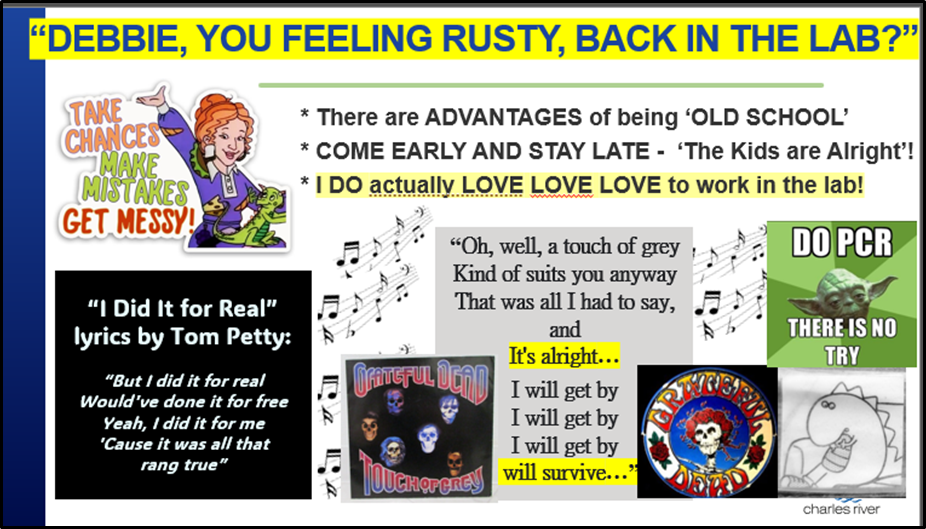
Even though it was next-generation science, I went into my sabbatical with an “old school” mindset. I relied on old-fashioned notetaking skills, filled multiple binders with publications and protocol advice, asked lots of questions, and did everything I could to write down all the “turn by turn” steps of the experiments. And I started trucking down the highway of learning.
I have to say that one of the first advantages I noticed from taking a dedicated sabbatical time to learn certain aspects of NGS HTS was that I went from being a curious listening member of the Advanced Virus Detection Technologies Working Group, supported by the Parental Drug Association, to a more curious listener, who understood volumes more. I also learned that a major motivator to this NGS work has been the U.S. Food and Drug Administration’s Arifa Kahn, of the Molecular Retrovirology Unit, Division of Viral Products, Office of Vaccines Research and Review, in the Center for Biologics Evaluation and Research. Here is a quote from one of her many presentations about NGS: “…it is complex technology, and use of this advanced method for adventitious virus detection raises challenges in standardization, validation, and bioinformatics, including the need for large data analysis and storage and follow-up strategies for confirmation of results.”
Yes, my sabbatical project was to learn and understand this technology more than I had, and it was a benefit to have ready-made materials to test in my hands, because using my hands and feeling out the visuals of the experiments, then performing them, is where I learn best. Maintenance of a workflow kept materials segregated, safer from contamination, and suitable for use. For example, each lab had its own lab coat color, and manipulations were contained in segregated, clean biosafety cabinets. No surprise to the molecular biology world, there were a lot of reagent steps to keep track of. Of course, I knew that you have to keep reagents cool and keep your own cool by staying organized. It was great that the kit reagents came in color-coded caps. (I love colors and even gave a presentation for our Charles River student science fair recently.) And yes, I brought in my own color-coding system to the lab, too.
I first prepared a concentrated virus mixture by ultracentrifugation after carefully balancing the tubes. After nucleic acid isolation, one does a “library prep” which molecularly tags the strands of DNA/RNA, important for systematic sorting later on in the data analysis. I am not new to lab work, so I wrote everything down in my trusty notebook and worked in a clean “workstation”. My magnifying glass also came in handy for those increasingly tiny numbers on the tubes for my vintage eyesight. I changed gloves a lot and kept a “thinking chair” in the lab space too, so that I could study methods and write up my experiments. I took my time to learn it right, the first time, also allowing myself some space to repeat experiments if needed. I asked lots of questions. The isolations and library prep took me a solid two weeks the first time, as I took my time to understand the step-by-step process, even taking rest stops to give me time to ponder what I was learning. I decided to prepare materials three times, as a repetition and backup, since this was only 4 weeks total in time. I prepped one set on the first day and prepped two more sets the following day.
Sequencing for adventitious viruses is complex. In general, the flow is like stepping through our ABCD’s to A) pretreat the material; B) extract the nucleic acids; C) prepare a library (think of many books organized with covers that identify them), and D) do the sequencing. Steps “EFG” and all the rest of the alphabet become the crucial and time-consuming bioinformatics - the computer-based teasing out of data and relevance, a vast array of technical work. (If you know of any computer-kids, tell them to pursue a career in the bioinformatics field because science needs them.) Well, to my surprise, my experiments worked – not beginner’s luck but good teaching and good methods.
One last traveling reference: I was crossing a beautiful suspension bridge, taken by millions, and I marveled at the majesty of the steel towering over me. I was impressed with the visual beauty of engineering usefulness combined with its strength – it was sturdy – and I am sure and hopeful that the engineering designs allow it to withstand extreme weather conditions and whatnot. And surely it is tested for safety. Imagine the folks sitting up at the top and overseeing their work decades and decades ago – knowing that generations to come would benefit from their day-to-day, back-breaking work. Now imagine that small scale – at the lab bench – at the engineering discussions – at the data crunching – taking the small scale to take a big-view approach and see that our work does innovate the paths to successful treatments, allowing people (and pets) to keep moving with life-improving treatments, life-saving too, because our scientific work is the bridge to our clients’ needs. We have to be able to keep driving innovation. There are new roads to take.
I am thankful to have had my sabbatical deep dive into learning, and that a year later, now, it still resonates with me (even more) in my “sightseeing trips” into more of the science. I am inspired to keep learning, even if it is at my own pace, while balancing many other scientific and management tasks. I have decided to never stop learning, that is what drives me. And like when giving talks about my experience, including a talk that took me across that giant, spectacular bridge, I will always encourage others that they are able to take their own future into their hands, to take time to learn, to be supported by a desire to learn, and that like me, keep driving to the future.