

Careers
|
Regina Kelder
These Scientists Make Sense of Big Data
Helping advance life-saving medicines by getting the full power of vast amounts of data. A Q&A with three data specialists
There is no doubt that the world is awash in data. The amount of data generated by companies is exploding, yet most of us cannot begin to appreciate or understand how much work goes into maintaining the systems and platforms we depend upon to do our jobs.
Consider Charles River Laboratories, one of the world’s leading CROs. We are in the data business. Data engineers and data scientists help us to make this data more accessible and create novel insights from the volumes of data.
Two groups integral to a smooth flow of data are data engineers and data scientists. Data engineers develop, construct, test and maintain databases and large-scale processing systems. They make our mountains of data accessible, structure it in ways that enable new and better processes and standardize it to make it more valuable and consistent. Data scientists develop models and analytical tools to transform large and complex raw data into actionable insights. They enable automation in ways humans alone could never support by processing huge volumes of data and applying algorithms to find insights at scale. And they enable in silico science that has the promise of reducing drug discovery timelines by orders of magnitude, such as Logica™, a customized turnkey drug discovery solution launched last year that integrates world-leading laboratory capabilities with best-in-class AI-driven molecular design.
Eureka, which has been getting to know the technical side of our business through Q&As with different groups, linked up with Data Scientist Sihong Ma and Data Engineers Divya Mannava and Hima Kotamreddy to a closer look at their day-to-day jobs.
Eureka: What drew you to your career in data science/ data engineering?
Divya: I once attended Ralph Kimball’s data warehouse workshop which changed my life.

The magic of connecting various systems to bring the data together and tell the real story had a magnetic effect on me. It is match made in heaven. ?
Hima: When I learnt that [statistics + programming/computing power + large volumes of data] can make a difference in this world, there was no looking back.
Sihong: I’ve always liked solving logic problems. Sudoku and escape rooms were all satisfying to figure out. Exploring data to reveal fascinating patterns and insights is the same: it’s all one big puzzle.
Eureka: What you do specifically do at Charles River?
Divya: Build Enterprise Data Hub (EDH), the backbone of CRL digital journey, by integrating data from various systems, consolidating data, and creating a model that is fit-for-purpose.
Hima: I am a technical lead on the Data Enablement Squad for Biologics line of business. Business understanding, data engineering and web services design are an integral part of my role.
Sihong: As a data scientist, I extract insights from vast and intricate data sets using statistical and ML methods. The aim is to inform decision-making and strategy.
Eureka: How does what you do fit into Charles River’s bigger picture of Creating, Healthier Lives? (In other words, how does what you do help our scientists and support staff function better?)
Divya: By connecting systems, automating workflows we bring reliable data that empowers our internal customers to take strategic and timely decisions. We also help in optimizing day to day operations.
Hima: Reliable fit for purpose data that our team works on is the backbone for analytics dashboards/KPIs which bring decision making power to the fingertips of business users.
Sihong: The Data Science team enhances CRL's scientific, operational, and commercial capabilities with advanced analytics, optimizing resources, promoting 3Rs and driving CRL’s market differentiation.
Eureka: What is one thing people get wrong about data scientists or data engineers?
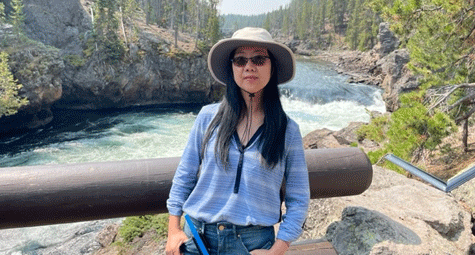
Divya: One misconception is that the data engineers can only work on data Pipelines and SQL. However, data engineers require a variety of technical skills and collaboration with wide range of stakeholders.
Hima: Data engineering effort does not have an impactful visual component to present. Hence, it is easy for people to get wrong about the magnitude of work.
Sihong: That data scientists only need to be experts in programming, statistics, and machine learning, but in reality, to be a great one, they must also gain domain expertise and develop soft skills.
Eureka: Where is your favorite place to mine for data?
Divya: Domain data
Hima: Data is ubiquitous. It depends on my data quest. Recently, I mined data from YouTube explainer videos by skill competency and generated knowledge graphs.
Sihong: As data comes in diverse forms and from various sources, there isn't a single favorite place for mining data.
Who is your favorite movie AI / robot and why?
Divya: Chitti , a character from Indian Sci-Fi movie called Robot. It can do anything.

Hima: WALL-E. It made me think how the future would be if robots can learn empathy and feelings.
Sihong : C-3PO is my favorite robot - loyal, intelligent, and amusing - the perfect companion to have by your side.
Eureka: What is making you laugh lately?
Divya : My 2-year-old drama queen who can imitate mom’s reaction to her mischievous behavior.
Sihong : I enjoy watching the adorable Panda Huahua's YouTube shorts; her daily antics always make me laugh and brighten my day.
Eureka: If your life were a hashtag what would it be?
Divya : #LuckFavorsTheBrave
Hima : #LearnShareInspire
Sihong : #OneMinuteAtATime