
What Are Irradiated PBMCs?
Irradiated PBMCs are PBMCs that have been exposed to X-ray radiation to prevent proliferation without affecting their viability, thus supporting use in immune assays where you want to retain PBMC activity, such as antigen processing and cytokine production, without them expanding in culture.
Irradiated PBMCs from Charles River
Standard vial sizes are available (25M, 50M, and 100M cells), as well as custom options.
| Size | Product Code |
|---|---|
| 25 x 10e6 cells | PB009C-IRRD-2 |
| 50 x 10e6 cells | PB009C-IRRD-50 |
| 100 x 10e6 cells | PB009C-IRRD-3 |
| Custom | PB009C-IRRD-KIT* |
Contact us if you don’t see a specific product, size, or format, or if you would like to customize your request.
*Product is made to order.
-
Discounted Pricing
Your company or academic institution may be eligible for pricing discounts. Government labs located in the United States are also eligible for GSA MAS discounts. Request a quote to find out more.
Why Use Irradiated PBMCs?
Designed for non-proliferative use in immune workflows, irradiated PBMCs are used when researchers need to maintain PBMC functionality in an assay while minimizing the risk that PBMC proliferation affects downstream readouts.
Irradiated PBMCs Use Cases
Irradiated PBMCs are commonly used for stimulation, antigen processing and presentation, cytokine release, and feeder cell applications to support the survival, activation, and rapid expansion of target cells in immune cell assays. Irradiated PBMCs are particularly important for supporting the expansion and activation of immune cells in cellular therapies such as tumor-infiltrating lymphocytes (TIL) and T cell and NK cell therapies. They are also used for vaccine development, immunological assays such as mixed lymphocyte reactions (MLR), and the establishment of pluripotent stem cell cultures.
Applications
Stimulator / Antigen-presenting Cell Workflows
Use irradiated PBMCs as stimulators or antigen-presenting cells to support immune activation workflows while limiting proliferative carryover.
Feeder Cell Support
Use irradiated PBMCs as feeder cells to support the survival, activation, and rapid expansion of target cells in immune assays and for cell therapy development.
Key Benefits and Considerations
- High viability and non-proliferative by design for cleaner co-culture experiments
- Cryopreserved format supports consistent, repeatable setup
- Available in multiple vial sizes plus custom options
- Irradiated PBMCs are typically treated as single-use assay reagents and are not intended for expansion in culture. Plan cell numbers accordingly.
Ready to Order? Here's Some Guidance
Be prepared to tell us the following when placing an order:
- Desired vial size (25M / 50M / 100M) or custom cell number
- Number of vials / total cells needed
- Any donor preferences (if applicable to your supply model)
- Intended use (stimulator, feeder, APC) to help confirm it
If you need a specific cell number, packaging format, or study-aligned requirements, request a custom configuration using PB009C-IRRD-KIT*.
Contact us if you don’t see a specific product, size, or format, or if you would like to customize your request.
*Product is made to order.
Related Products
Explore additional PBMC formats from Charles River:
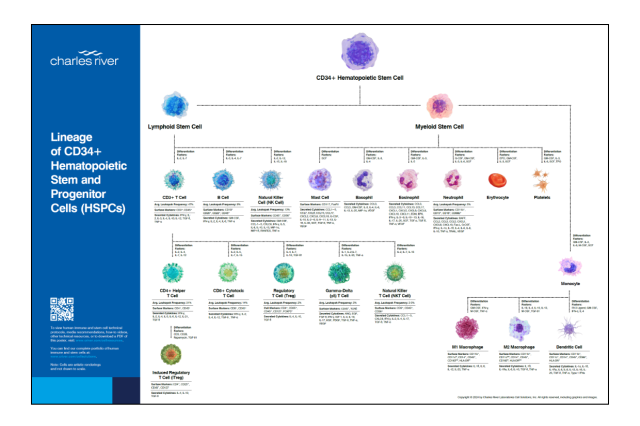
Lineage of CD34+ Hematopoietic Stem and Progenitor Cells (HSPCs)
Receive a complimentary poster to access information on immune cell markers, differentiation factors, cytokines, technical protocols, media recommendations, and how-to videos.
Frequently Asked Questions (FAQs) About Irradiated PBMCs
-
Are irradiated PBMCs alive?
Yes, irradiated PBMCs are alive but will not divide, so they are for single-use in cell co-cultures. Our irradiated PBMCs have >90% viability post-thaw.
-
How are PBMCs irradiated?
PBMCs are irradiated by exposure to an X-ray source at a specific dose to induce sufficient DNA damage to stop cell division.
-
Is there an alternative to irradiating PBMCs?
Yes. As an alternative to radiation, PBMCs can be treated with mitomycin C instead to achieve a similar effect. Mitomycin C is a naturally occurring DNA crosslinking agent that prevents cell division.
The downside of mitomycin C is that it is extremely toxic and requires incubation and multiple washes to ensure no residual mitomycin C is carried over to the cells in your culture. During incubation and washing, as much as half of the starting PBMCs can be lost.
This is why researchers typically prefer not to use mitomycin C and instead recommend irradiated PBMCs that are ready to thaw and use.
-
Why are X-rays used to irradiate PBMCs instead of another radiation source?
Using X-rays as a radiation source instead of Gamma rays from Cesium-137 is less hazardous and produces no radioactive waste, making us more environmentally friendly. With X-ray, there is no risk of ionizing contamination, as no radiologic material is used.
-
How should irradiated PBMCs be thawed?
Proper thawing technique is crucial to ensure the viability and functionality of cryopreserved cells. We recommend that you follow these steps for best results.