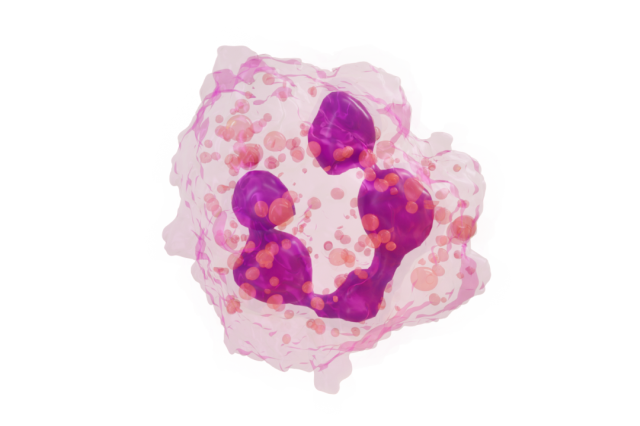
Types of Granulocytes
- Neutrophils - are the most common type of granulocytes. Like all granulocytic cells, they are produced by the bone marrow and form an essential part of the innate immune response. Neutrophils are one of the first responders of inflammatory cells, arriving at the site of injury within minutes of trauma. The mature neutrophil lives only a few hours or perhaps a little longer after migrating to the tissues. A large number of neutrophils are held in reserve in the bone marrow to accommodate for their short lifespan.
- Eosinophils - are types of granulocytes that are involved in most, if not all, immune responses. They control mechanisms associated with allergies and asthma and can also combat multicellular parasites such as worms.
- Basophils - are the least common type of granulocytes, but also the largest. They produce compounds that help coordinate the immune response, including histamine, serotonin, and heparin.
Validated Purity
Granulocytes from Charles River are guaranteed >90% purity by flow cytometry and >95% viability by flow cytometry. In the figure below, neutrophils are isolated from a population of peripheral blood mononuclear cells (PBMCs), after which cell population purity is validated by flow cytometry.
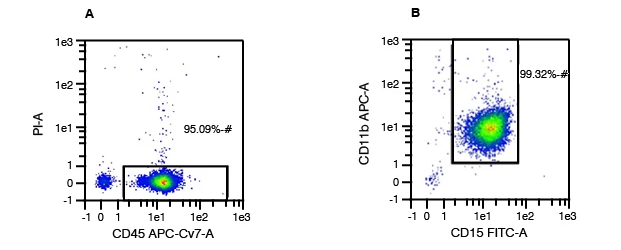
In Panel A, CD45 and Propidium Iodide (PI) are used to assess purity and viability of the PBMCs. CD45 is expressed on all leukocytes and is used to indicate purity of the white blood cell (WBC) component. Because PI cannot pass through the membrane of live cells to stain DNA, it serves as an indicator of viability. Representative data shown here indicates purity of 95.09% – meaning >95% of cells in this sample are WBCs. (May not be indicative of received samples.) CD15 is a cell surface antigen found on all neutrophils. CD11b is cell surface protein involved in adhesion and migration to sites of infection and inflammation. CD11B is expressed on the surface of monocytes, macrophages, and granulocytes. When comparing levels of CD11b versus CD15 (Panel B), the purity of the sample for neutrophils can be assessed. This graph shows a representative data set with purity of 99.32%. (Actual purity may vary somewhat from sample to sample.)
Charles River granulocytic cells are purified from peripheral blood, characterized by flow cytometry, and then cryopreserved in a serum-free and protein-free fully defined cGMP CryoStor™ CS10 cryopreservation medium (BioLife Solution, Seattle, WA).
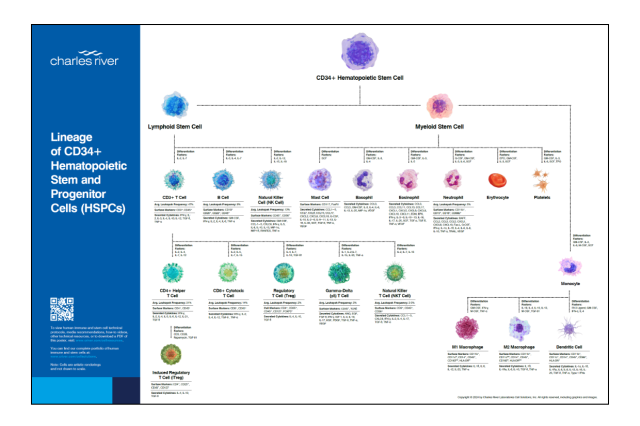
Lineage of CD34+ Hematopoietic Stem and Progenitor Cells (HSPCs)
Receive a complimentary poster to access information on immune cell markers, differentiation factors, cytokines, technical protocols, media recommendations, how-to videos, and more.
Granulocyte Clinical Applications
- Granulocyte transfusion - Prolonged disease, aggressive chemotherapy, and stem cell transplant can result in severe depletion of neutrophils and other granulocytic cells. Granulocyte transfusion is used to fight off the increased risk of viral, fungal, and bacterial infections that result when granulocytic cell counts are too low.
- Cellular immune therapies - Clinical trials are ongoing in which preparations of immature human immune cells known to replenish neutrophil populations are infused into patients whose immune systems are weakened by leukemia treatment. Researchers hope the treatment will help prevent infection and shorten hospital stays for immunocompromised patients.