
Researcher Profiles
|
Regina Kelder
A Lifetime of Learning for a Veterinarian from Puerto Rico
Attending veterinary school is a huge undertaking for any student. But imagine doing it as a single mother, in a foreign land?
Veterinarian Dania Del Castillo-Pratts didn’t have to look far for strong female role models. Her mother, Dr. Ivette Pratts, is a well-known rehab medicine doctor in Puerto Rico and her grandmother was a social worker. But truth be told, it was the cows, horses, and other farm animals that she woke up to every day, and grew to love, that probably had the most influence on her career choice.
Dania’s childhood community was decidedly urban, but like many Puerto Rican families, animals were part of the extended family. She was surrounded by hens that supplied her family with eggs, cats, dogs, and rabbits. For her 15th birthday, her quinceañera, her father gave her a horse. “Since I was a little girl, people would always ask me, ‘What do you want to be when you grow up?’ And I was like, veterinarian of course. I always say that I felt like I was born to do this,” says Dania.
Today, Dania is a Senior Staff Veterinarian at Charles River Laboratories. Her current position at a quarantine center represents the latest chapter in a long career working with animals large and small. It is her team’s job to make sure the animals under their temporary care are free of any pathogens that could compromise research studies. Her site provides an early yet important service in the preclinical testing of new drugs or vaccines, including several of the recent COVID vaccines.
Admittedly, the road to career success has not been an easy one for Dania, starting with her decision to leave Puerto Rico to work as a vet tech in Florida, and ultimately to enroll in Tuskegee’s College of Veterinary Medicine in Alabama. Only 32 US institutions offer programs in veterinary medicine compared to 172 medical schools, and only about 10-15 percent of applicants are accepted every year. It is far more difficult to be accepted into a US vet school than a US medical school, even more so for Puerto Ricans like Dania because most schools typically choose just one student from her territory each year.
Dania was also a divorced single mother with a young child when she made the decision to leave home and embark on her dream. Balancing work life and home life, making sure her son’s needs were met, while working and attending school, was difficult. As a Hispanic woman she was also part of an underrepresented group in US veterinary practice, and as such felt as though she needed to work harder to prove herself.
“I’m lucky that I had financial support from my family,” says Dania speaking of her middle-class family upbringing. “But there are a lot of Hispanic people that don't have that. So, it's even a bigger challenge for them to be what they want to be and to afford it.”
From Vet Tech to Veterinary Medicine
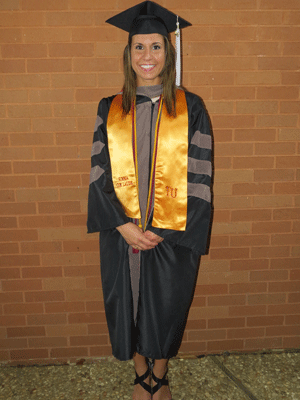
When we think of veterinarians, we often think of the specialists who treat our beloved family pets. But the field is much wider than that, with lots of opportunities in research and sub-specialties. When she was attending college in Puerto Rico, Dania did a rotation at a research laboratory supported by the US National Institutes of Health that has been critical for national and international researchers in the study of numerous diseases. Her main role was to ensure the safety and welfare of the animals housed in this facility. She monitored their vitals and reported any ailing animals to the staff veterinarians. Dania didn’t fully realize this at the time, but she had found her niche, the work that would make her professionally satisfied. After receiving her undergrad, she continued working at the animal research center for two years. Itching for more opportunities, she applied for a job as a vet tech at an academic-based vivarium in Florida that housed both large and small animals. One of the veterinarians saw Dania’s resume, was immediately impressed by her background, and flew her up for an interview.
The move was both professionally and geographically daunting. Dania freely admits crying her eyes out when she and her son boarded the plane for the US, leaving Puerto Rico—where family is everything—behind. Having her mother and brother with her the first few weeks to smooth the transition helped though, and she quickly settled into her new position. Within a year she was promoted. Before long, she was eyeing vet school, fulfilling a childhood dream. Her son was a little older, so she felt she could take the leap and sent applications to five schools. Tuskegee University, which enrolls a higher percentage of out-of-state students, accepted her.
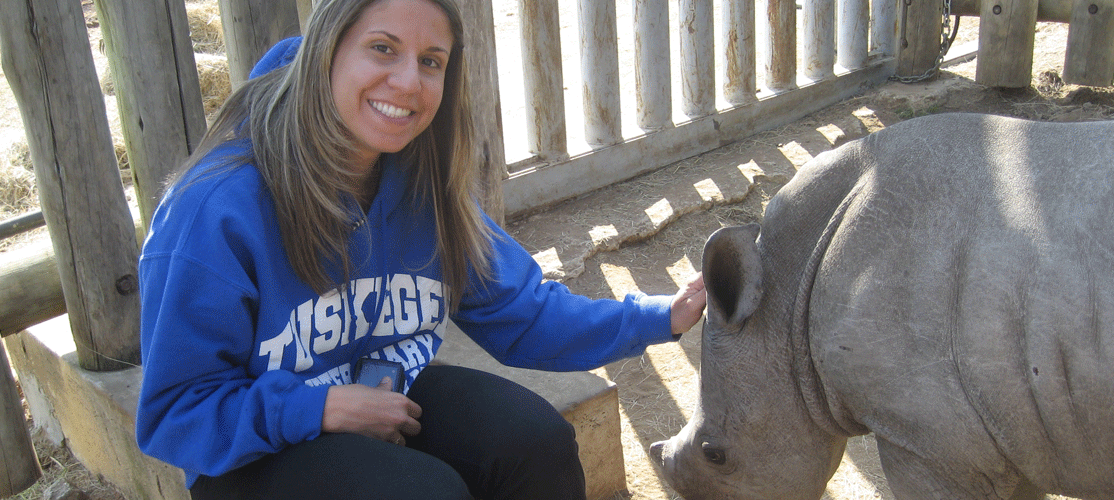
“It wasn’t easy, of course. I had to study a lot, but I was determined to finish [school],” says Dania, who eventually graduated summa cum laude. “Also, because I was little bit older than my classmates – they were in their early 20s and I was already in my 30s—I felt I had to prove to myself that I could do this.” It helped that Dania’s boyfriend, an IT specialist whom she met in Florida, was able to join her for her final two years of school. As an added challenge, they planned their wedding and got married during her junior year. During her time at Tuskegee, Dania spent a rotation in South Africa with another veterinarian, where she encountered rhinoceroses like Valentine, shown in the main image above.
Back to the research lab
After vet school, Dania completed an emotionally and physically grueling internship in Florida at
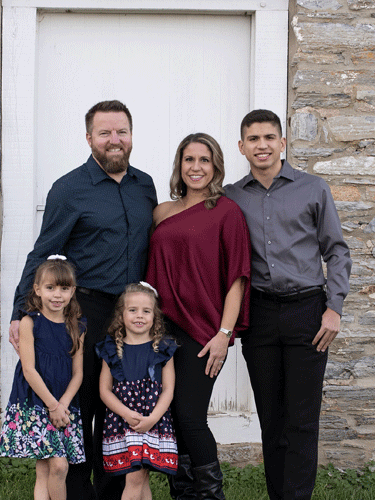
an emergency and surgery center, specializing in the complex treatments of domestic animals, mostly cats and dogs. For the first time in her career, her clients were pet owners, and she was having to deal with not only medical issues but owner’s financial concerns due to the cost of care. Even then, she could feel the pull back to research and the care of larger animals. Now pregnant with her first daughter, Dania decided to postpone her residency and continue working to raise her child and provide for her family.
Eventually she returned to the large animal research community, first at a center in Florida and eventually with Charles River, where she has worked for the past three years. Her eldest child, the one that traveled all the way with her from Puerto Rico to the States, is now 21 and a computer science major in college. She has two daughters as well. Always learning, Dania is now trying to get her board certification in lab animal medicine.
“Our field and the work we do is so important, I want to make sure I am the best that I can be, says Dania. “No matter what job you do in research, don’t be afraid to talk about it and educate others on the importance of what you do for humanity. Especially during the pandemic, we all played a big part in getting life back to normal as quickly as possible. I think people will respond to that.”
So, with Hispanic Heritage Month upon us, what advice does Dania have to offer from her years of vet education and training? “It is challenging, coming from a different culture and speaking English as a second language, but if you continue to learn, work hard, and never shy away a challenge, your teachers and supervisors will take notice. I certainly found that out.”
This blog article is part of Eureka's ongoing coverage of Hispanic Heritage Month. Check out this earlier story about Venezuelan computer engineer Patty O'Callaghan.