Safety Assessment
|
Daniel Klein
Military Medical Research - A Battle Against Life-Threatening Diseases
Life-saving military medical research benefits more than just soldiers. Learn how military research agencies, specifically veterinary pathologists, have contributed to furthering public health.
When scientists found the first evidence of vaccine-induced protection against HIV, the discovery did not come from an academic lab or a pharmaceutical company, it came from the HIV Military Research Program . The trial of 16,000 low-risk individuals, carried out in partnership with the Thai government, marked a turning point in the faltering field of AIDS vaccine research.
This is just one example of how military research agencies have contributed to furthering public health. The Department of Defense’s laboratory for biological defense research — USAMRIID — researches therapeutics, vaccines, and diagnostics, as well as investigates disease outbreaks such as Ebola and influenza. And the Walter Reed Army Institute of Research is developing a COVID-19 vaccine that could potentially be effective against Omicron and all of SARS-CoV-2’s other variants, as well as previous SARS-origin viruses. Although military medical research is focused on maintaining the health of their troops, their research often has benefits for civilians.
Military medical research a good training ground
While there are broad multidisciplinary medical teams on the frontlines of military medical
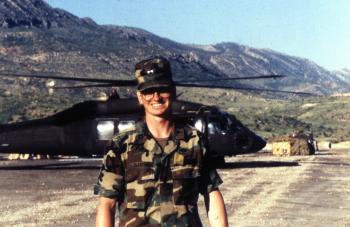
Provide Comfort to help Kurdish refugees.
research, veterinary pathologists are critical players in studying outbreaks and emerging diseases. “The US military has really focused on developing people through additional education. And because it's so difficult from a monetary standpoint for the government to hire a veterinary pathologist out of the civilian world, they have done an extremely good job of offering training avenues to help people develop into those specialties along the way,” says Gary Coleman, a senior veterinary pathologist at the Charles River Ashland site. “Over my 26-year career, the Army gave me a world-class education in pathology and opportunities to work with some incredible individuals and some incredible institutions. That's why I started and why I stuck with it as long as I did.”
Though he began in military medical research, Coleman’s career eventually drifted towards more administrative work. At one point, he was deputy director for the Department of Defense’s veterinary services. "We had technical oversight of all veterinary services that are provided by the Department of Defense around the world. Everything from preventative medicine to animal care to medical research,” says Coleman.
Coleman is far from the only ex-military pathologist working at Charles River. Veterinary pathologist Mark Smith of the Reno site spent years focusing on biological defense research at USAMRIID and Walter Reed. “[We did] research into viral diseases like Ebola, Marburg, Lassa fever, and smallpox. We used the monkey pox as sort of our stand-in, since smallpox wasn't something we actually used,” says Smith. A significant amount of work was done in the high-level BSL labs, which Smith describes as “essentially the same job, just harder, because you're wearing the suit and lots of pairs of gloves.”
Military medical research of vaccines, radiation injuries
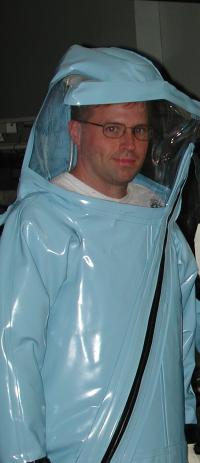
he wore in the BSL-4 lab.
A great deal of military medical research at Walter Reed is focused on vaccine development. One of Smith’s major projects was a now-approved vaccine for Ebola. Denzil Frost, one of the Reno site’s Senior Anatomic Pathologists, worked on the development of a vaccine for Staphylococcal Enterotoxin B, one of the most potent bacterial superantigens. “It’s something that grows in egg salad when it’s left out,” says Frost, “but the potential threat is if you put it in a ballistic shell and explode it a thousand yards in the air. If you breathe it, it's very, very lethal.”
Although the infectious diseases and defenses against possible biologic agents get a lot of attention, they’re far from the only focus. Leonora “Lea” Dickson, a veterinary pathologist at the Durham site, began her career as an enlisted service member before leaving to get her degree in veterinary medicine. She returned to the Army after obtaining her veterinary degree, finishing her service years as a veterinary pathologist. While at the Walter Reed Army Institute of Research, her work included military medical research on traumatic brain injuries, and later worked at the Armed Forces Radiobiology Research Institute on acute radiation injuries. Her efforts were focused on how it was affecting the bone marrow and the gastrointestinal tract. “Once it affects the brain and vasculature, really there's nothing that can be done,” notes Dickson. She speaks highly of her military experience: “I was just grateful just to be able to make the contribution. … The research that we do supports the service members as well as the civilian sector. I was proud to be a part of that team.”
Dickson was not the only one who mentioned the feeling of teamwork and comradery. The “most fulfilling job” Coleman has had involved supporting the Kurdish refugees in Iraq during Operation Provide Comfort. “I was the veterinarian who was charged with ensuring that all of the food that was donated by about 26 or 27 countries around the world was inspected and safe and wholesome when it went forward to the camps.” In both the military and the civilian sector, the need for food inspection causes a large demand for veterinarians — Dickson and Frost did food inspection in the earlier part of their careers as well.
The safety assessment work they do now is a similar vein, using their professional expertise and skills to identify problems and make the world a better place. “Any job eventually kind of becomes routine because we tend to forget what the impact is,” says Coleman, “[Provide Comfort] was one place where, on a day-to-day basis, I could see exactly what the impact was of the work that my team was doing.”