
FVB Mice Details
Derived in 1935 from an outbred Swiss colony [N:GP(S)] at NIH. In the early 1970s, while being established as an inbred strain, sensitivity to Friend leukemia virus B strain was discovered. At this time inbreeding of this line for the Fv1b allele was undertaken and the strain was called FVB. To Charles River from NIH in 1994. We also offer FVB SOPF Mice.
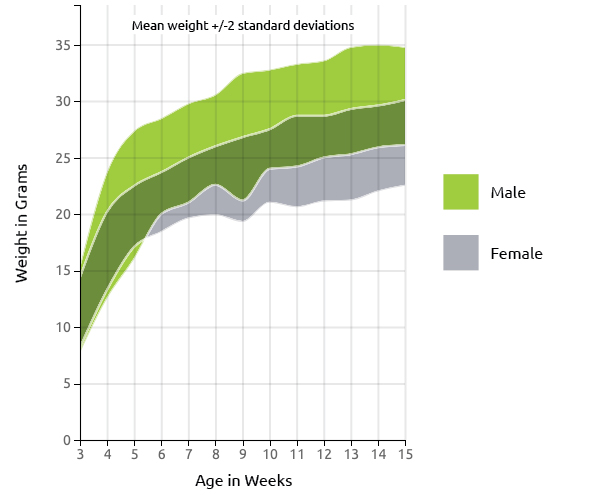
LOCATION: Raleigh
UNIT: R07
Download the Report
➤ DOWNLOAD OUR CATALOG for instant access to Standard List Pricing
➤ TALK TO US to discuss organization or volume-based discounts
Already have an eCommerce portal account?* Login to order research models, obtain quotes, view organization-specific pricing, and see inventory. Processing time required to validate new eCommerce access requests.
*eCommerce is available in US, Canada, UK, France, Germany, Austria, Netherlands, Denmark, Finland, Norway, Sweden, Spain, Portugal, Belgium, Luxembourg, and Switzerland
Try out this model with our animal evaluation program (North America)
Try out this model with our animal evaluation program (Europe)
FVB Mice Details
Derived in 1935 from an outbred Swiss colony [N:GP(S)] at NIH. In the early 1970s, while being established as an inbred strain, sensitivity to Friend leukemia virus B strain was discovered. At this time inbreeding of this line for the Fv1b allele was undertaken and the strain was called FVB. To Charles River from NIH in 1994. We also offer FVB SOPF Mice.
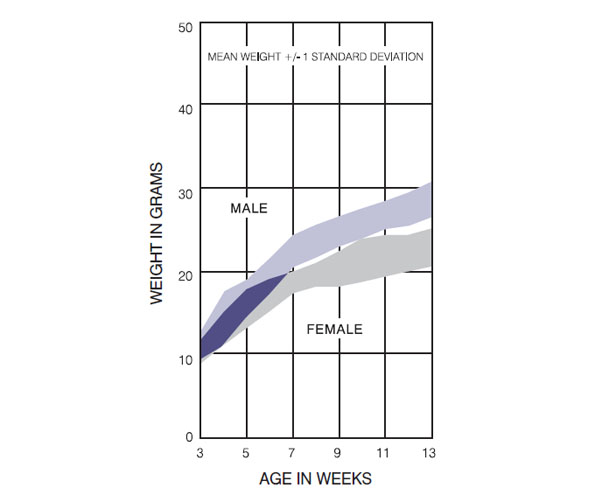
Growth chart data should be used as a guideline only.
The shaded areas on each chart are the mean weight plus or minus one standard deviation at a given age averaged across all production facilities. This represents approximately 67% of the population, with the remaining 33% falling outside of this weight range.
UNIT: 9
Download the Report
➤ DOWNLOAD OUR CATALOG for instant access to Standard List Pricing
➤ TALK TO US to discuss organization or volume-based discounts
Already have an eCommerce portal account?* Login to order research models, obtain quotes, view organization-specific pricing, and see inventory. Processing time required to validate new eCommerce access requests.
*eCommerce is available in US, Canada, UK, France, Germany, Austria, Netherlands, Denmark, Finland, Norway, Sweden, Spain, Portugal, Belgium, Luxembourg, and Switzerland
Try out this model with our animal evaluation program (North America)
Try out this model with our animal evaluation program (Europe)
FVB Mice Details
Derived in 1935 from an outbred Swiss colony [N:GP(S)] at NIH. In the early 1970s, while being established as an inbred strain, sensitivity to Friend leukemia virus B strain was discovered. At this time inbreeding of this line for the Fv1b allele was undertaken and the strain was called FVB. To Charles River from NIH in 1994. We also offer FVB SOPF Mice.
Growth chart not available
Please email us at [email protected] to request a health report for this model.
For additional information, including pricing details, please visit the FVB mouse page on the Vital River Laboratories website.
Try out this model with our animal evaluation program (North America)
Try out this model with our animal evaluation program (Europe)
Learn more about our Transgenic Model Creation Services
GUIDEBOOK
Rodent Model Genetic Quality Control
Learn the essentials of genetic QC programs: inbred/outbred colony quality control, transgenic rodent model creation, rederivation, and cryopreservation techniques. Download Now
Frequently Asked Questions About FVB Mice
-
What are FVB mice?
FVB mice are a strain of laboratory mice that are commonly used in biomedical research. They were originally developed in the 1980s and are known for their high reproductive rates and susceptibility to developing certain tumors.
-
What makes FVB mice useful in biomedical research?
FVB mice are useful in preclinical biomedical research because of their susceptibility to certain tumors, which can be used to study cancer biology and test potential treatments. These mice are also commonly used in studies of reproductive biology, as they have high reproductive rates and are easy to breed.
-
How do researchers use FVB mice in oncology research?
Oncology researchers use FVB mice to study the mechanisms of tumor development, test potential cancer treatments, and evaluate the effectiveness of cancer drugs in preclinical trials.
-
What other types of research are FVB mice used for?
In addition to oncology studies, FVB mice are also used in immunology, neuroscience, and reproductive biology studies.
-
Why are FVB mice used in neuroscience research?
FVB mice have a number of characteristics that make them useful in neuroscience research. One is a high reproductive rate, which makes them useful for breeding experiments. They also have relatively consistent behavior patterns, which makes it easier to study the effects of different drugs or treatments on their neural activity. Another benefit of using FVB mice is that they are relatively easy to work with. They are docile and can be handled easily, which makes it easier to collect data and perform experiments. And because they are an inbred strain, they are genetically similar to one another, which reduces the amount of variability in experimental results.
FVB mice are used in a wide range of neuroscience experiments, including studies of neural development, behavior, and disease. They are often used as a model organism to study diseases such as Alzheimer's and Parkinson's, as well as to test the efficacy of new drugs or treatments.