
Leverage Our NKT Cell Isolation Expertise to Advance Your Research
NKT cells represent only about 2-5% of the peripheral blood mononuclear cells (PBMCs) and less than 0.1% of the total T cell population,(1) making it difficult to isolate them due to their rarity and need for specialized donor recruitment expertise to ensure sufficient NKT cell yields from leukopak collections. With our made-to-order NKT cells, you get access to the expertise of our donor recruitment and scientific teams to secure appropriate donors in our large, diverse, and characterized donor pool that can yield high NKT quantities while ensuring high quality.
Made-to-Order Specialized Human Natural Killer T Cells
- NKT cells are isolated from leukopaks collected onsite at our donor center from a pool of strategically selected healthy donors that have consented under an IRB approved protocol.
- NKT cells are isolated via automated immunomagnetic cell separation procedures and using optimized SOPs developed in-house to ensure high quality and yield of NKT cells.
- NKT cells are cryopreserved immediately following isolation, and post-thaw QC is performed on every NKT lot using flow cytometry analysis to guarantee that viability is ≥ 90% and purity is ≥ 70% as assessed by the CD3+CD56+ population out of CD45+ viable cells.
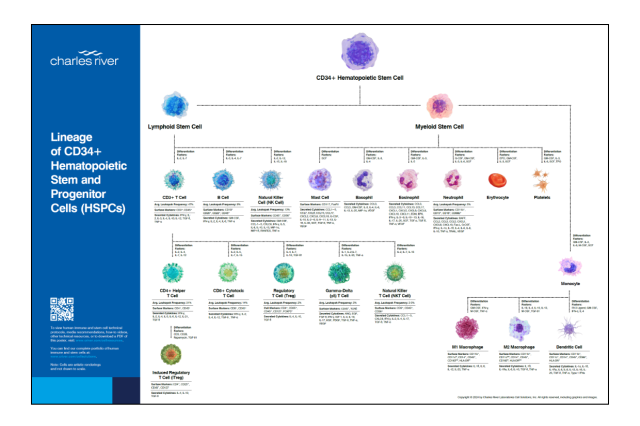
Lineage of CD34+ Hematopoietic Stem and Progenitor Cells (HSPCs)
Receive a complimentary poster to access information on immune cell markers, differentiation factors, cytokines, technical protocols, media recommendations, how-to videos, and more.
Characterization of Human Natural Killer T Cells
Figure 1 shows flow cytometry characterization from a representative NKT production highlighting the percentage of cells expressing dual CD3+CD56+ receptors, the TCR Vα24-Jα18 receptor which is expressed by the invariant or type I subset of natural killer T cells, the CD314 receptor (NKG2D) which is an activating receptor of natural killer and natural killer T cells, and the CD16 receptor (FcγRIII) which is expressed by certain subsets of natural killer cells resulting in activation of antibody-dependent cell-mediated cytotoxicity. Based on twelve different NKT productions, we find that on average the viability is 95%, purity (CD3+CD56+ cells) is 84%, 27% of the NKT cells are positive for TCR Vα24-Jα18 expression, 73% of the NKT cells are positive for CD314 expression, and 34% of the NKT cells are positive for CD16 expression.
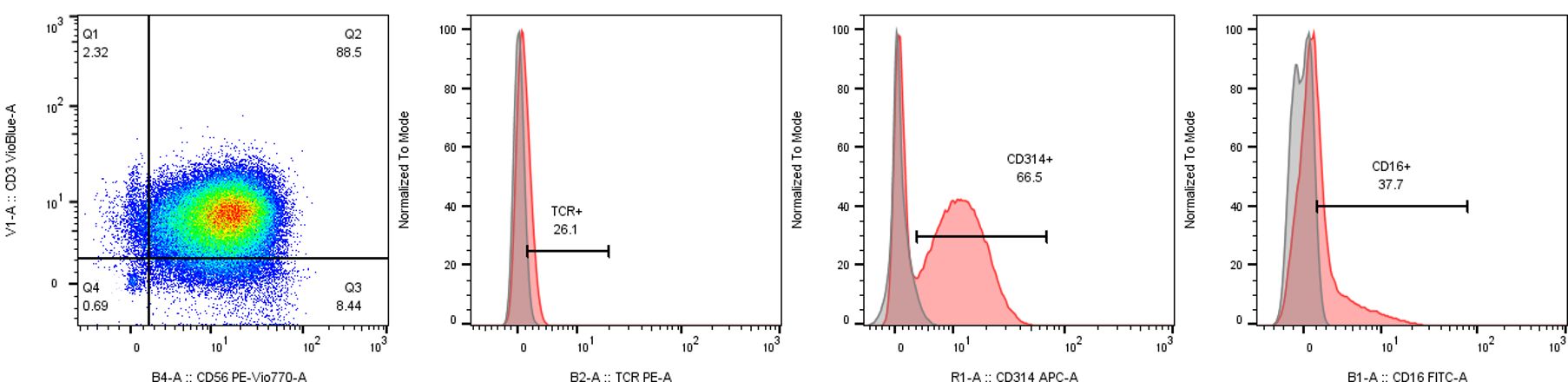
Figure 1. NKT Flow cytometry characterization from a representative production lot. A) CD3 versus CD56 flow plot gated on CD45+ viable cells, showing the percent CD56+CD3+ cells for this lot to be 88.5%. B) 26.1% of the cells are positive for TCR Vα24-Jα18 which recognizes glycolipid antigen, including α-galactosylceramide (αGalCer), presented in the context of CD1d. This TCR is expressed by the invariant or type I subset of natural killer T cells. C) 66.5% of the cells are positive for the CD314 marker, also known as NKG2D, which is an activating receptor of natural killer and natural killer T cells. NKG2D binds to proteins that are overexpressed on cells during infection, transformation, and stress, resulting in cell activation and killing of the affected cell. D) 37.7% of the cells are positive for CD16, also known as FcγRIII, which is expressed by certain subsets of monocytes and natural killer cells. These receptors bind to the Fc portion of IgG antibodies, resulting in activation of antibody-dependent cell-mediated cytotoxicity.
Why are Human Natural Killer T Cells Unique?
NKT cells are T lineage cells that share morphological and functional characteristics with both T cells and NK cells including expression of CD3 and CD56 surface markers. NKT cells can be activated through the TCR Vα24-Jα18 and recognition of glycolipid antigens bound to the CD1d receptor on antigen presenting cells, through the killer cell immunoglobulin-like receptors (KIRs) and natural killer cell receptors (NLRs), and through cytokines like IL-12, IL-18, and interferon-γ (IFN-γ).(2)
Below is a list of characteristics highlighting the importance and unique functions of NKT cells:
- Activated NKT cells can immediately initiate cytokine secretion to kill the invading microorganisms or tumor cells, which puts NKT cells in the very first lines of innate defense. In addition, many cytokines secreted by NKT cells can promote differentiation and functions of conventional T cells. These properties make NKT cells a unique research tool linking adaptive and innate immunity in response to pathogens.(1)
- Activated NKT cells can secrete a broad array of cytokines and chemokines, by which they can promote or suppress the immune response through activation of additional effector cells.(1)
- NKT cells exhibit a potent anti-tumor function through direct cytotoxicity or through activating CD8+ cytotoxic T cells. NKT cells also play an important role in tumor immunosurveillance and anti-tumor immunity by having the ability to effectively traffic to the tumor site and disrupt the suppressive activity of tumor associated macrophages (TAMs) and myeloid-derived suppressor cells (MDSCs) in a CD1d-dependant manner.(1)
- NKT cells have minimal risk of graft-versus-host disease (GvHD) due to lack of MHC engagement, which makes them an ideal candidate for immunotherapy development.(1)
- CAR-NKT can provide a potent anti-tumor therapy that can modulate the tumor microenvironment (TME) through simultaneous depletion of TAMs and tumor cells using TCR/CD1d and CAR recognition, respectively, as well as generalized elimination of both via NK receptors.(1)
- Mazinani, M., Rahbarizadeh, F. New cell sources for CAR-based immunotherapy. Biomark Res 11, 49 (2023)
- Hadiloo K, Tahmasebi S, Esmaeilzadeh A. CAR-NKT cell therapy: a new promising paradigm of cancer immunotherapy. Cancer Cell Int. 2023 May 8;23(1):86.