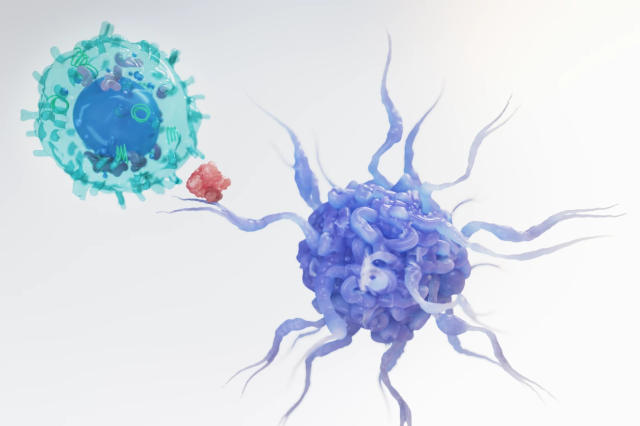
Antigen-specific T Cells: A Discovery Tool for Investigating Immune System Activity
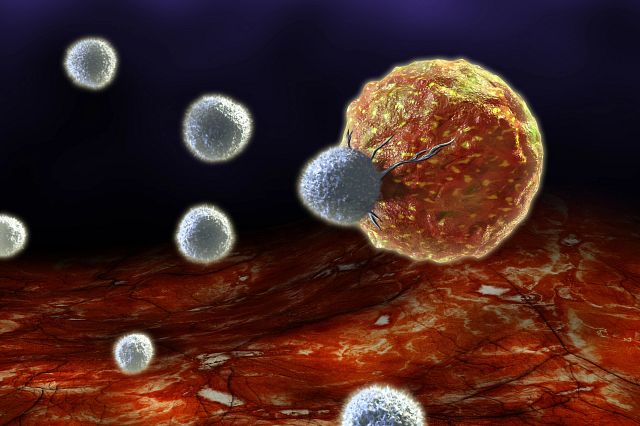
We have developed a range of activated antigen-specific CD4+ T cells and antigen-specific CD8+ T cells that recognize specific antigens. T cell activation is achieved by interaction between the T cell receptor (TCR) and the MHC complex on the surface of an antigen presenting cell (APC) that is displaying the immunogenic peptide of interest. Due to the unique structure of the TCR, individual T cells can recognize a specific sequence of peptides (antigen-specific) derived from viruses, bacteria, tumor cells, or normal tissue as in the case of autoimmune disease. Frequency of these activated antigen-specific T cells is very low among circulating T cells, making them very difficult to isolate and study their immune response. Thus, antigen-specific T cells present a powerful tool to help develop treatments and cures for cancers, infectious diseases, and autoimmunity.
Our antigen-specific CD4+ T cells and antigen-specific CD8+ T cells are derived through initial priming with APCs displaying the antigen of interest, followed by subsequent expansion in vitro. These antigen-specific T cells express native TCR molecules from a specific donor and have undergone multiple rounds of expansion during the production process. The antigen-specific T cells are not purified/sorted from donors, lentiviral transduced or genetically modified, or derived from established clones or immortalized cell lines.
Buy Antigen-specific T Cells
| Associated Disease | Antigen-specific T Cells, Cryopreserved | Size | Product Code |
|---|---|---|---|
| Autoimmune Disorders | GAD65 (555-567) T Cells Myelin Basic Protein T Cells ProInsulin T Cells (PI-1) | 1-2 x 10e6 cells 1-2 x 10e6 cells 1-2 x 10e6 cells | ASTC-1127 ASTC-1022 ASTC-1115 |
| Cancer | HER2/neu (369-377) T Cells MAGE A10 T Cells MART-1 T Cells NY-ESO-1 T Cells WT-1 T Cells | 1-2 x 10e6 cells 1-2 x 10e6 cells 1-2 x 10e6 cells 1-2 x 10e6 cells 1-2 x 10e6 cells | ASTC-1126 ASTC-1125 ASTC-1072 ASTC-1093 ASTC-1089 |
| Microbial | Tetanus Toxoid T Cells | 1-2 x 10e6 cells | ASTC-1075 |
| Viral Pathogens | CMV Specific CD4+ T cell line CMV Specific T Cells, HLA-B*35 restricted CMV T Cells, HLA-A*0201 restricted EBV-Specific T Cells HPV E7(11-19) T Cells HPV E7(11-20) T Cells HPV E7(82-90) T Cells HSV gD1 (53-61) T Cells Influenza (M1) T Cells SARS-CoV-2 S424-433 T Cells | 1-2 x 10e6 cells 1-2 x 10e6 cells 1-2 x 10e6 cells 1-2 x 10e6 cells 1-2 x 10e6 cells 1-2 x 10e6 cells 1-2 x 10e6 cells 1-2 x 10e6 cells 1-2 x 10e6 cells 1-2 x 10e6 cells | ASTC-1122 ASTC-1048 ASTC-1049 ASTC-1083 ASTC-1099 ASTC-1084 ASTC-1123 ASTC-1092 ASTC-1039 ASTC-1142 |
Contact us if you don’t see a specific product, size, or format, or would like to customize your request.
Your company or academic institution may be eligible for pricing discounts. Government labs located in the United States are also eligible for GSA MAS discounts. Request a quote to find out more.
Buy Antigens and Peptides
Antigens and peptides are used to produce the antigen-specific T cells and to test their functionality.
- Available in 100 µg/vial or 1 mg/vial sizes, depending on the specific antigen
- All antigens/peptides are tested for bioactivity using Charles River PBMCs. View our product portfolio.
- Antigen-presenting cells (dendritic cells and B cells) are also available for purchase separately.
| Associated Disease | Antigen-specific T Cells, Cryopreserved | Size | Product Code |
|---|---|---|---|
| Autoimmune Disorders | GAD65 (555-567) Peptide MBP (84-97) Peptide Proinsulin (73-90) Peptide | Antigen-1135 Antigen-1053 Antigen-1119 | 1 mg 1 mg 1 mg |
| Cancer | HER2/neu (369-377) Peptide MAGE (A10) Peptide MART-1 (26-35) Peptide NY-ESO-1 (157-165) Peptide WT-1 (126-134) Peptide | Antigen-1136 Antigen-1138 Antigen-1109 Antigen-1095 Antigen-1090 | 1 mg 1 mg 1 mg 1 mg 1 mg |
| Microbial | Tetanus Toxoid Antigen Tetanus Toxoid (830-844) Peptide | Antigen-1002 Antigen-1054 | 100 μg 1 mg |
| Viral Pathogens | CMV Antigen CMV pp65 Peptide (A2 restricted) CMV pp65 Peptide (B35 restricted) HPV (11-20) Peptide HPV E7 (11-19) Peptide HPV E7 (82-90) Peptide HSV Glycoprotein D Peptide Influenza A-M1 (58-66) Peptide SARS-CoV2 S(424-433) Peptide | Antigen-1004 Antigen-1051 Antigen-1052 Antigen-1055 Antigen-1133 Antigen-1134 Antigen-1094 Antigen-1114 Antigen-1148 | 100 μg 1 mg 1 mg 1 mg 1 mg 1 mg 1 mg 1 mg 1 mg |
Contact us if you don’t see a specific product, size, or format, or would like to customize your request.
Your company or academic institution may be eligible for pricing discounts. Government labs located in the United States are also eligible for GSA MAS discounts. Request a quote to find out more.
Applications of Antigen-specific T Cells
Antigen-specific T cells can be used as a positive control in potency assessment assays for tumor-specific cell therapy products. The tumor killing activity by antigen-specific T cells can be used as a reference value against which different batch productions of cell therapy products can be measured. Large lots of ready-to-use antigen-specific T cells are an ideal positive control for assay validation, setting release criteria, and Quality Control.
In addition to evaluating the efficacy of tumor cell killing by cell therapy, antigen-specific T cells are also suitable for testing the ability of immunomodulators, such as PD1 Inhibitors, to enhance the killing of tumor cells.
Live cell imaging-based assays (IncuCyte) can be used to visualize the killing of tumor target cells that are co-cultured with the effector cells (antigen-specific T cells). In this type of assay, the target tumor cells are labeled with a dye or florescent protein prior to co-culture with the antigen-specific T cells, thus allowing for their identification and subsequent quantification of the antigen-specific T cells' cytotoxicity.
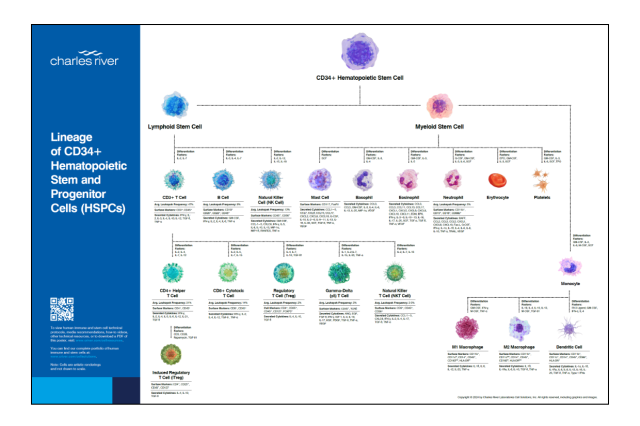
Lineage of CD34+ Hematopoietic Stem and Progenitor Cells (HSPCs)
Receive a complimentary poster to access information on immune cell markers, differentiation factors, cytokines, technical protocols, media recommendations, how-to videos, and more.
Example of Characterization Using MART-1 Antigen-Specific CD8+ T Cells
Anti-MART-1 (26-35 ELAGIGILTV) CD8+ T cells were stained in the presence of either a negative control tetramer or a MART-1 tetramer to assess binding specificity. As shown in Figure 1, MART-1 antigen-specific CD8+ T cells did not bind with the negative tetramer (left dot plot) whereas 85% of the MART-1 activated CD8+ T cells showed specificity to the MART-1 tetramer (right dot plot). Functional characteristics of these MART-1 Antigen-specific T cells were verified through IFN-γ production and by a cytotoxicity assay in response to MART-1 antigen stimulation (Figure 2).
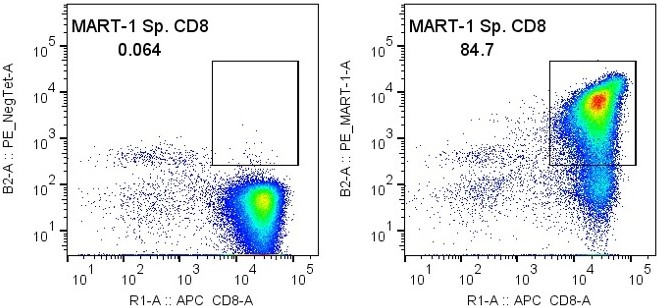
Figure 1. Antigen Binding Specificity of the MART-1 antigen-specific T cells. HLA-A*02:01 restricted MART-1 (26-35, ELAGIGILTV) antigen-specific CD8+ T cells were stained in the presence of either a negative control tetramer (left dot plot) or a MART-1 (26-35, ELAGIGILTV) tetramer (right panel). As shown in the right dot plot, about 85% of the MART-1 activated CD8+ T cells are positive for binding to the MART-1 (26-35, ELAGIGILTV) peptide.
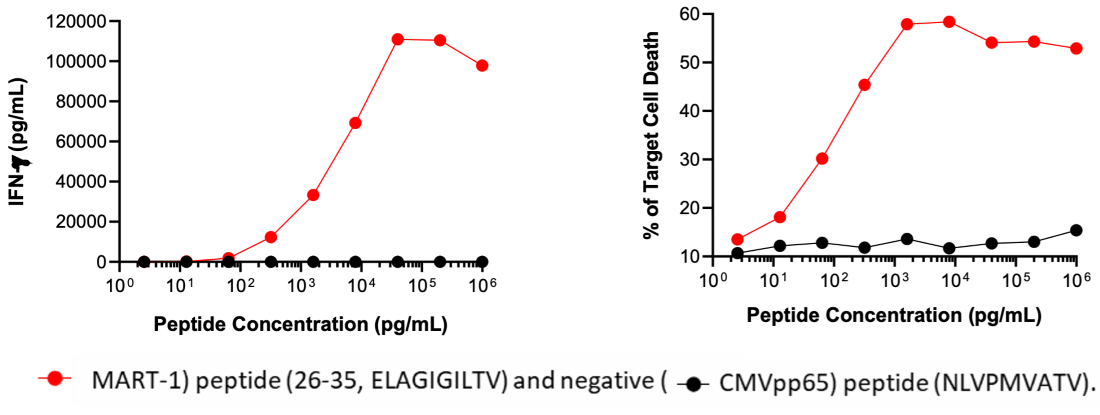
Figure 2. Functional characterization of the MART-1 antigen-specific CD8+ T cells: Production of IFN-γ (left panel) and killing of target cells (right panel) are assessed in the presence of MART-1 antigen-specific T cells and APCs with increasing concentration of HLA-A*02:01 restricted MART-1 peptide (red lines) or an irrelevant CMV peptide as a control (black line).
Utility of Antigen-Specific T Cells (ASTCs)
This webinar highlights the usage of antigen-specific T cells when developing immunomodulatory therapeutics to a wide range of diseases caused by viruses, bacteria, tumor cells, and autoimmunity.
Watch On Demand