
Anxiety and depression are highly complex mental health conditions that show significant overlap in pathology. Although both can be standalone conditions, they are often symptoms of other developmental, psychiatric, or neurodegenerative disorders, including Alzheimer’s disease, Parkinson’s disease, Huntington’s disease, and autism spectrum disorder.
We provide a full range of assays used in the development of compounds to treat anxiety and mood disorders, including the "gold standard" assays that show high predictive validity, as well as newer approaches that are being researched and identified. Our extensive experience in anxiety and depression behavior tests, as well as comprehensive range of imaging modalities and biomarker analysis capabilities, provides unmatched services for mental health drug discovery.
Elevated Plus Maze
The elevated plus maze test is the most commonly used behavior test to examine anxiety-like behaviors in rodents and is frequently used to screen compounds for potential anxiolytic activity, for both acute and chronic pharmacological treatment.
Elevated Plus Maze Protocol and Data
The elevated plus maze is based on a rodent’s innate dislike of heights and open space. An elevated maze with two open arms and two closed arms is used, and the time spent in the different arms is recorded, along with entries into the different arms, as a measure of anxiety-like behavior. Anxiolytic compounds, such as diazepam, increase the time spent in the open arms of the maze.
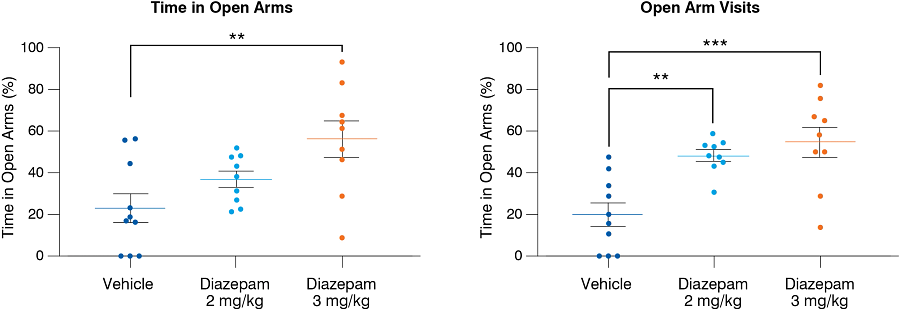
Effect of diazepam treatment in bal/c mice on performance in the elevated plus maze, showing increased frequency of open arm visits and increased total time spent in open arms. Time in open arms (%), mean ± SEM. Time in open arms; one-way ANOVA: p = 0.0072, Dunnett’s multiple comparison tests: vehicle vs. diazepam 2 mg/kg, p = 0.27, vehicle vs. diazepam 3 mg/kg, p = 0.0037. Open arm visits; one-way ANOVA: p = 0.0003, Dunnett’s multiple comparison tests: vehicle vs. diazepam 2 mg/kg, p = 0.0024, vehicle vs. diazepam 3 mg/kg, p = 0.0003.
Chronic Social Defeat Stress
Chronic social defeat stress is a commonly used behavioral test to model depression and anxiety-like behaviors in rodents. Compared to other models, chronic social defeat stress is shown to induce behaviors that more accurately reflect the human symptoms of depression and anxiety. In this behavior test, naïve mice are exposed to an intruder animal in a cage separated into two compartments. The confrontation between naïve mouse and intruder generates physical and sensory stress, which induces depression-like behaviors that are long-lasting and reversible.
Marble Burying Test
Mable burying test is used to examine the effect of therapeutic candidates on anxiety-like behaviors, as well as repetitive behaviors such as those seen in obsessive compulsive disorders. Mice displaying anxiety-like behaviors will naturally dig in substrate in their cage and bury any marbles in the cage as a consequence. On the day of testing, mice are placed into a new home cage containing glass marbles for 30 minutes. The number of marbles buried as well as distance travelled and latency to start burying are recorded as measures of anxiety-like behavior. When treated with compounds that have anxiolytic effects, mice show decreased marble burying behavior.