Microbial Solutions
|
James Cooper, PharmD
20 Years of Trailblazing Science with the LAL Cartridge
Charles River’s invention, which 20 years ago made LAL testing simpler, faster and less reliant on the horseshoe crab, continues to evolve, this time into recombinant territory
Is a highly skilled, dedicated analyst needed to conduct a routine bacterial endotoxins test (BET)? By the year 2000, major parenteral drug firms were conducting the BET—which is designed to detect all environmental Gram-negative bacterial endotoxins—with the aid of an incubating microplate reader and endotoxin-specific software. The advent of the chromogenic substrate in 1982 produced a more robust color signal than did turbidity in kinetic LAL methods.
Despite these advances, many QC supervisors were frustrated with the high percentage of invalid BET results. Moreover, some companies operated with limited microbiological staff, forcing them to send their BET samples to contract labs to reduce invalidity.
So, Charles River Laboratories Microbial Solutions, a leader in LAL testing, began exploring more modern options to the early gel-clot method that, while widely accepted, posed more of a risk for human error and compromised data integrity.
The Age of LAL Cartridges Begins
Under the tutelage of Foster Jordan, who joined Charles River in 1994 following the acquisition of Endosafe®, Charles River launched a revolutionary hand-held, rapid endotoxin detection test. Jordan sought to eliminate the technical flaws and weaknesses of early photometric BET methods by creating a new automated microfluidic test platform that utilized a single-use cartridge with dried, embedded reagents. But creating a completely automated and more robust LAL test would require a total redesign of existing LAL reagents and photometric readers.
Recognizing there was simpler, faster, more automated solution, Foster began collaboration with a company that specialized in microfluidic test systems. Charles River acquired this technology in 2001 and thus began bringing forth the industry-changing LAL cartridge technology platform. Among the initial features like dried, pre-calibrated and pre-loaded stabilized reagents, Foster created an archived standard curve, established from known reference standard endotoxin values, eliminating the lengthy time and experience required by the technician of preparing a daily standard curve. Patents were filed and granted. Extensive conversations and negotiations with FDA began in 2003, primarily concerning the, at the time, novel features like the archived standard curve, its linearity, system suitability, negative and positive controls, manufacturing requirements, and software design.
The archived standard curve, a key part of the invention, represented a completely new approach for the field of microbial identification and more specifically endotoxin testing, and required multiple data sets to validate its accuracy to the regulators. Charles River needed to re-educate regulators on why this was important in reducing the variability of the control standards.
Why was the LAL Cartridge Such a Major Advance?
The uniqueness of the LAL cartridge could not be overstated. Among the advantages:
- Reduces the amount of LAL reagent up to 95% compared to the gel-clot assay
- A quantitative kinetic chromogenic assay accepted by FDA and complies with harmonized BET chapters (USP/Ph. Eur.)
- Real-time results in approximately 15 minutes
- Simple to use, cutting down on the time it took laboratories to train and qualify new analysts
- Eliminates complexity and subjectivity with the built-in archived standard curve, the main source of error in the gel-clot test.
- Reduces manual pipetting, diluting, reconstituting steps, and consumables which requires less glassware, plastic accessories, and eliminates reagent waste.
A cartridge and associated Endosafe instrumentation that uniquely allow for unprecedented collection and electronic documentation of results; the cartridge and automated / robotic endotoxin technologies allowed laboratories to better utilize their highly trained, highly-educated scientists and analysts. In short, the lower variability achieved with the LAL cartridge meant that laboratory retest rates dropped dramatically along with the time needed to retest murky results. And, since the cartridge technology did not require water for BET to prepare the liquid reagents, the principal reason for the negative controls was eliminated.
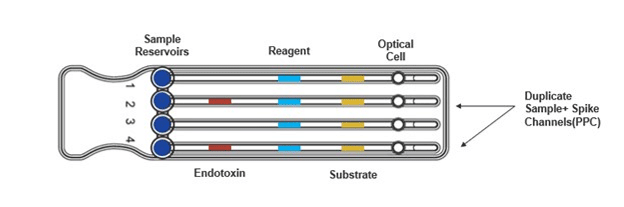
Recognizing that the new approach to BET was a significant advance toward production of safer parenteral products, the FDA approved the cartridge in 2006 (see image below). The new system was named PTS, for Portable Test System, to emphasize the suitability of its ability to perform testing at the point of use or point of sampling, freeing it from strict performance in a firm’s QC lab.
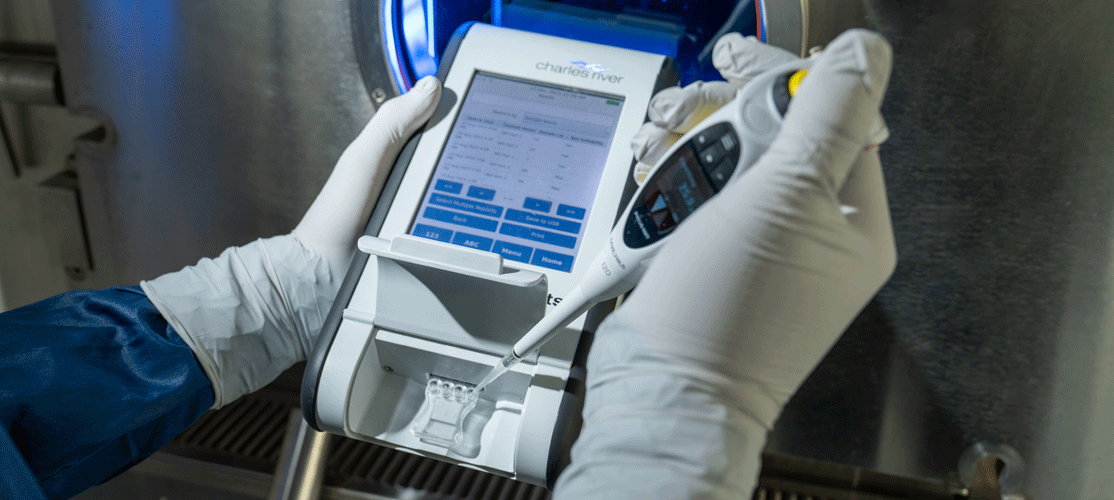
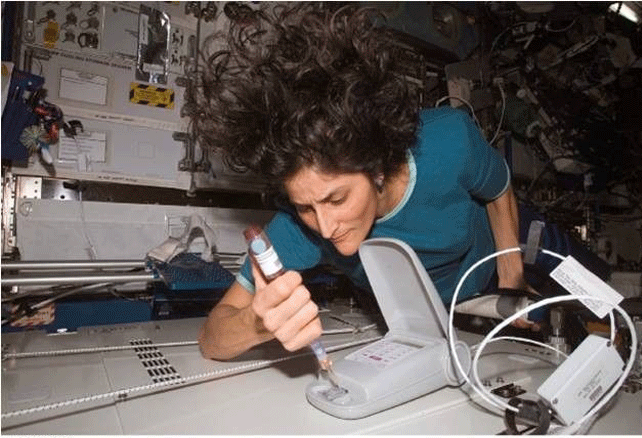
Among the early users of the Endosafe®-PTS™ product was in fact, NASA. They used the cartridge technology to monitor the environment for microbial contamination during the construction of the Mars exploration rovers, “Spirit” and “Opportunity” and deployed the Endosafe®-PTS™ aboard the International Space Station (see image below) to assist in studies for an extended human presence in space.
The Ever-Evolving Cartridge
Arguably, Charles River’s invention of the PTS was the most important innovation in BET testing since the introduction of the chromogenic substrate. But the innovation didn’t end there. Over the years, Charles River introduced new variations on the LAL cartridge including:
- Endosafe® nexgen-PTS™, which included an embedded operating system for true portability. It was designed for wireless capability for remote system access, and data export and printing.
- Endosafe® nexgen-MCS™, which provides a stackable, multi-cartridge system that allow you to test up to five samples simultaneously in approximately 15 minutes. The samples are run independently, allowing for random access, and eliminating the need for batch sampling.
- Endosafe® Nexus 200™, a fully automated robotic system designed specifically for testing in the central quality control lab. It ties together LAL cartridge technology, full automation of liquid handling, and simple data management.
Recombinant Cascade Reagent (rCR) Cartridges
With last year’s launch of an animal-free, recombinant cascade reagent, Endosafe® Trillium™, Charles River has introduced the next iterations of the flagship cartridges in 2024. The rapid and robust Trillium cartridges fully align with the existing suite of scalable, automated, Endosafe cartridge technology platforms, utilizing the same kinetic chromogenic testing method and sample preparation. Labs are still able to receive quantitative results in approximately 15 minutes, expediating their endotoxin testing program to keep pace with their manufacturing and production timelines. The beauty of this flexible technology allows for customers to transition from LAL to rCR cartridges seamlessly, as the LAL cartridges that users have trusted for decades will continue to be available.
With 20 years of cartridge technology behind us, what will the next two decades bring? Stay tuned!
The Micro Keeps You in The Know
You don't need an agar plate to grow your microbial knowledge. Get industry updates, articles and other resources delivered straight to your inbox each month with this microbiology newsletter.
Subscribe