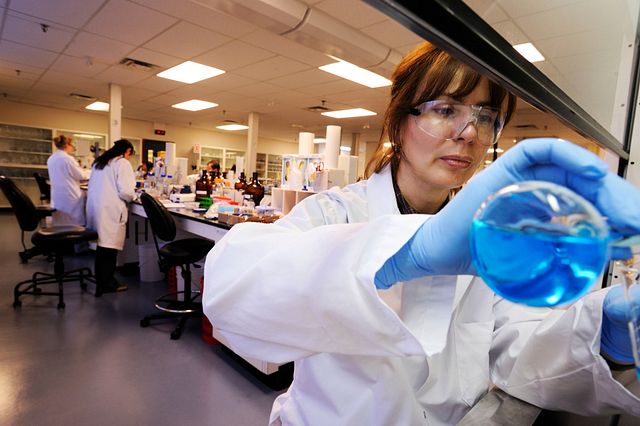
Preformulation Screening Through to Formulation Development
Selecting the correct solid form for use in formulations ensures consistent bioavailability and formulation stability. By using polymorph screening, salt screening, and a suite of solid form characterization techniques, our scientists ensure that they understand the physical properties of the APIs they are working with, resulting in the identification of appropriate formulation strategies to improve exposure.
We offer a comprehensive package of formulation discovery and development activities in a vast array of formulation types. From preformulation investigations and screening to formulation validations, stability assessments, compatibility, and assessment of suitability with dosing apparatus, our experience is unmatched. Extensive global Analytical Chemistry groups using state-of-the-art instrumentation are available to support our formulation development services. Successful formulation development requires knowledge of the physicochemical characteristics of the drug. To achieve this goal, we conduct preformulation screening prior to formal formulation development experiments.

eGuide: Bioanalysis from Early-Stage to Clinical Drug Development
Accounting for modality complexity, evolving regulatory expectations, and the critical importance of upfront planning, this eGuide explains how to identify risks early and align your bioanalytical strategy with the needs of your compound, your timeline, and your team.
Learn More
Contract Pharmaceutical Formulation Development Services
-
pH Solubility Profiling
Since ionizable entities in a drug molecule can significantly alter the solubility profile and the nature of its interaction with the cell membrane and the target site, it is important to assess the relative solubility of ionizable drug molecules at various pH levels. Data derived from such experiments can provide the basis for optimizing the final formulation, and optimum solubility can often facilitate higher drug absorption.
-
Dose Suitability
Preclinical formulations, especially those used for oral dosing, are often formulated using high concentrations of test article. As a result, the physical characteristics of the formulation may not be readily predictable. It is important to assess the stability, ease of preparation, suitability, and other physical characteristics of a formulation during dosing. This information adds confidence and aids in minimizing complications and delays in future preclinical studies.
-
Compatibility
Identifying the compatibility (or incompatibility) of a new drug molecule with the appropriate container and dosing apparatus is essential for developing a good experimental design. The identification and resolution of such issues as early as possible ensures a successful study with minimal time delays.
-
Bioavailability Enhancement
Poor drug solubility often correlates with poor bioavailability. The use of cosolvents, solubilizing excipients, and biological enhancers can improve both solubility and drug absorption. In the instance where solubility is very low enabling technologies, such as ASDs, nanosuspesnions and lipid based formulations can be considered. However, a critical balance must exist between improving solubility and minimizing unnecessary side effects. By working closely with our Discovery and Toxicology in vivo scientists, our chemists can optimize formulations for improved results and minimal toxicity of formulation components.
Connect with Us
Our Formulation Development Service Facilities and Equipment
All of our facilities have laboratories suitable for the preparation of dosing formulations. Each laboratory is equipped to prepare formulations of any batch size required for preclinical programs and is designed to eliminate cross-contamination. Full accountability of test article usage is maintained at all stages, as required by Good Laboratory Practice (GLP). Formulated products are stored under pre-defined controlled conditions. Analyses of dosing formulations for identity, accuracy, homogeneity (if applicable), and stability are conducted in one of our Analytical Chemistry laboratories.
The Dispense™ software system is used throughout the formulation process to maintain a full record of test item usage, from initial receipt through formulation and dispensing to disposal. Extensive use of bar coding and online electronic data capture from the balance ensures a high level of data integrity and minimizes the potential for error.
Analytical Chemistry Services for Formulation Development
We have considerable experience in analytical method development and validation, as well as the subsequent analysis of dose formulation samples, inhalation chamber atmospheres, and bulk test articles.
Chemical analysis of dose formulations, inhalation chamber atmospheres, and bulk test articles is a regulatory requirement for GLP studies. Analysis of dose formulations, whether solutions, suspensions, or dietary mixtures, is required to verify the concentration accuracy and homogeneity of the formulation used for in vivo dosing or in vitro testing during nonclinical programs. Stability of the dose formulations under the conditions of the study is also verified.

Dispelling the “Cookie Cutter” Fallacy of Small Molecule IND
View this webinar to discover how to adapt your approach to your IND program’s unique challenges to gain a competitive edge.
Watch the Webinar
Chemical analysis of inhalation chamber or mask atmospheres serves a similar purpose. In general, the test article atmospheres are characterized for concentration and particle size distribution depending on the type of formulation (e.g., dry powders, liquids, metered dose inhalers, gases). Analysis of the chamber atmosphere provides a direct correlation of the dose delivered to the animals at the breathing zone. Particle size distribution analysis is used to calculate the estimated achieved dose and demonstrate that the test atmospheres are respirable.
Analyses are performed by highly trained personnel who have a wide range of scientific skills and many years of experience. Method development is conducted by experienced staff who are responsible for the efficient transfer of clients’ methods, the development of assays from first principles, or the modification of existing methods as necessary.
Working with the analytical chemistry group, and specifically Maryann Nolan, Research Scientist, Mattawan, MI, has gone smoothly for over three years... She delivers reports on time, and they are always of high quality. I cannot say enough great things about how wonderful it is to work with Maryann, particularly on more challenging moieties like oligonucleotides.”
Dinah Misner, Senior Director, Aligos Therapeutics Inc.
Frequently Asked Questions (FAQs) on Pharmaceutical Formulation Development Services
-
What is pharmaceutical formulation development?
Pharmaceutical formulation is the multistep process where the active drug is mixed with all other components by considering the factors of particle size, polymorphism, pH, and solubility and becomes the final beneficial medicinal product. Benefits and constraints of the active pharmaceutical ingredients (APIs), valuable excipients, associated interactions, and manufacturing procedure are the four basic components for a successful pharmaceutical formulation. The formulation often functions in a way that includes different dosage forms. The dosage form is the pharmaceutical drug product as marketed for use with a specific mixture of active ingredients and inactive components. It has to be a particular configuration and distributed into a particular dose. [1]
-
What are examples of formulations you analyze or develop?
- Oral
- Solutions
- Suspensions
- Capsules
- SEDDS and SMEDDS
- Nano-suspensions
- Amorphous Solid Dispersions
- Dietary
- Pelletization or powder
- Parenteral
- Intravenous
- Intramuscular
- Subcutaneous
- Intraperitoneal
- Inhalation
- Dry Powder inhaled
- Nebulized formulations
- Topical
- Dermal
- Ophthalmic
- Intranasal
- Oral
-
What analytical techniques do you use for pharmaceutical formulation development?
- High performance liquid chromatography (HPLC)
- Ultra-high performance liquid chromatography (UPLC)
- Gas chromatography (GC)
- Gas chromatography–mass spectrometry (GC-MS)
- Liquid chromatography/mass spectrometry
- (LC-MS and LC-MS/MS)
- Atomic absorption spectroscopy (AAS)
- UV/Vis spectroscopy
- Fourier transform infrared (FTIR) spectroscopy
- Capillary electrophoresis (CE)
- Karl Fischer titration
- Inductively coupled plasma (ICP-OES, ICP-MS)
- Nuclear magnetic resonance
- Differential scanning calorimetry
- Thermogravimetric analysis (TGA)
- Laser diffraction
- Dynamic light scattering (DLS)
- Gravimetric vapor sorption
- Particle Sizing