What is Cryopreservation?
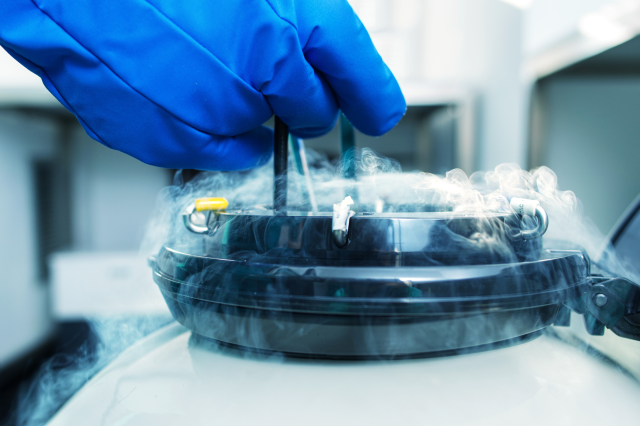
Cryopreservation is the process of freezing biological materials, typically in liquid nitrogen, at temperatures that reach -196 degrees Celsius to halt all biological activity and preserve them for future use. Sperm is collected from male mice and can later be used during in vitro fertilization; however, sperm cryopreservation is unavailable for rats. Rat and mouse embryos are collected and frozen primarily at the two-cell stage.
The Timely Benefits of Cryopreservation
Cryopreservation protects rare, custom, or proprietary rat and mouse strains from loss for many reasons, including facility disruptions, breeding failures, or even contamination. With clean recovery at any time, cryopreservation gives researchers another layer of operational flexibility and financial control, letting the research dictate your strategy. By enabling flexible project planning, activating spending pauses when funding is tight, and easily greenlighting model reconstitution when your studies dictate, researchers can archive underutilized lines instead of maintaining them.
Reasons for Cryopreservation
| Support Ethical Guidelines | Support the 3Rs by pausing work and restarting colonies when the timing is right. |
| Protect Your Irreplaceable Models | Don't let years of research get lost to contamination, facility shutdown, emergencies, staff turnover, or breeding failure. |
| Reduce Colony Costs | Save time and money by eliminating maintenance costs and reducing cage space and support staff. |
| Prevent Genetic Drift | Cryopreservation prevents the risk of subtle genetic changes and maintains the original genetic baseline. |
| Enable Sharing and Collaboration | Share strains with collaborators safely, quickly, and easily, even if the colony is no longer active. |
Do You Have the Right Cryopreservation Plan?
Not all strains, timelines, or research goals are the same, and the right plan will prevent wasted resources, lost animals, or failed recoveries. Single-gene mutations, such as homozygous knockouts/knockins mice, can use a simple sperm cryopreservation, but complex crosses or sex-linked mutations require a complete strategic plan for embryo cryopreservation. Choosing the wrong cryopreservation method can mean incomplete recovery or loss of key traits. With different timelines, IVF recovery and back-up storage need to be considered.
Researchers frequently cryopreserve underused or high-value strains. This proactive, cost-effective, and scientifically sound plan gives researchers peace of mind and greater control over their animal resources. These cryopreservation plans should include back-up storage, sample documentation, and plans for future use that align with your goals.
Our scientific experts want to partner with you to develop the right strategic plan for your research and help you ensure that your models can be recovered promptly, efficiently, and ethically.
Are You Ready to Recover Your Cryopreserved Lines?
The process of bringing your cryopreserved lines back to life can involve IVF, embryo transfer, and rederivation. If you are using sperm, IVF with fresh oocytes from females of the same background strain is used, and when the embryos are fertilized, they are implanted into a surrogate female. If embryos were cryopreserved they can be quickly thawed and directly implanted into female surrogates.
GUIDEBOOK
Rodent Model Genetic Quality Control
Learn the essentials of genetic QC programs: inbred/outbred colony quality control, transgenic rodent model creation, rederivation, and cryopreservation techniques. Download Now
Additional Services
Your research project doesn't stop with cryopreservation. Our GEMS team can help you bundle the right package for the next steps in your research.
| Colony Management | Rederivation | Embryology |
| • Housing and breeding • Husbandry services • Health monitoring • Dedicated project management • Internet Colony Management (ICM®) | • IVF colony expansion • IVF rapid expansion • Embryo rederivation • Sperm rederivation • Embryo transfer | • Rapid colony development • Model creation • Line rescue • MEA testing |
Choosing the Right Method for Your Research
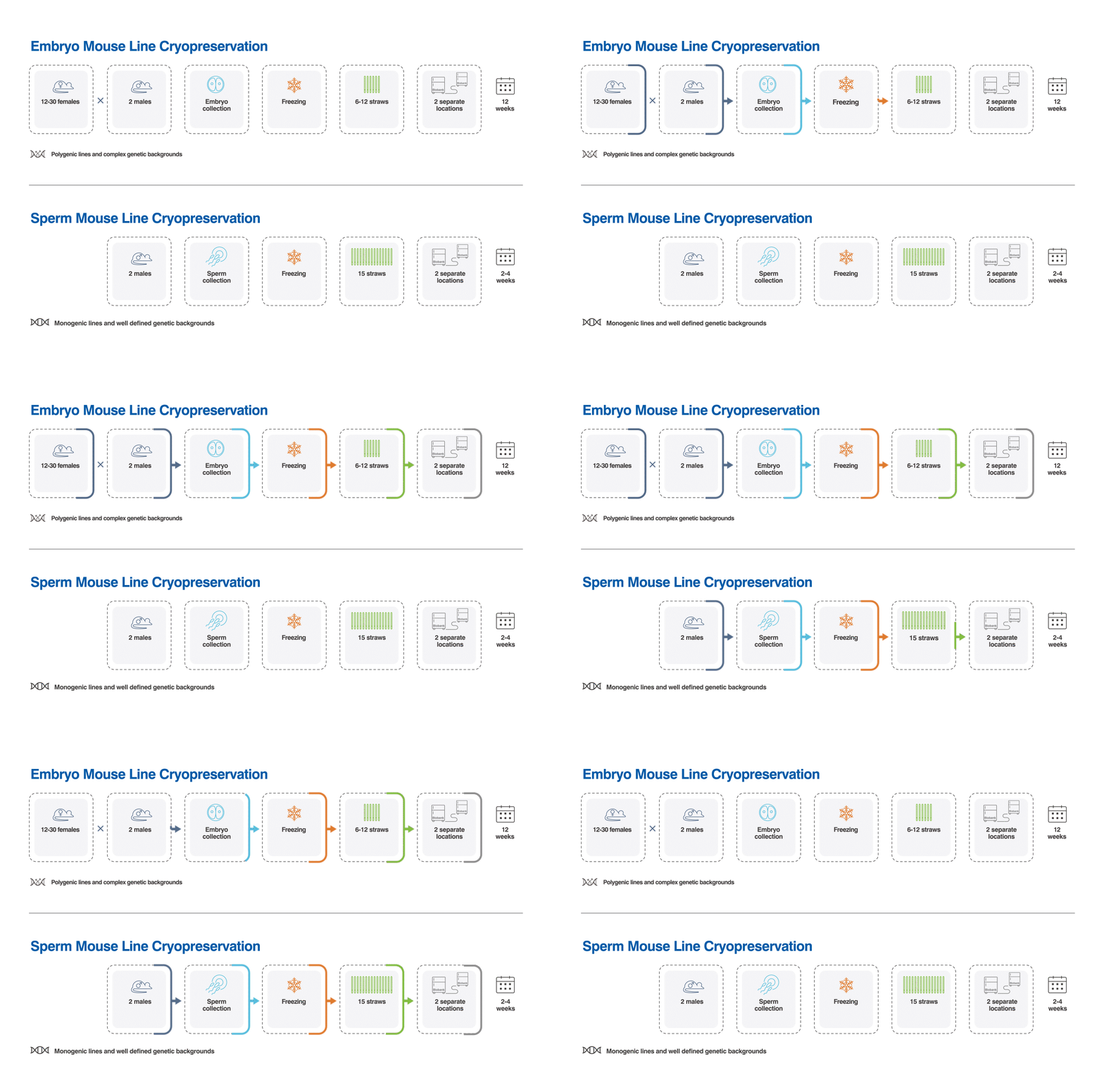
The image below compares embryo and sperm cryopreservation when it comes to animal numbers required, process, and timelines. Embryo cryopreservation is the only option available for rats. Further information can be found in our datasheet and in the FAQs.
Frequently Asked Questions About Rat and Mouse Cryopreservation
-
What types of materials can be frozen?
- Spermatozoa (mice only)
- Pre-implantation embryos (mice and rats)
See also:
Cryopreservation of Mouse Spermatozoa, N Nakagata; Mammalian Genome 11, 572–576 (2000) -
How does rat and mouse cryopreservation work?
The biological metabolism of living cells significantly decreases and eventually ceases at low temperatures, permitting the long-term preservation of living cells. There is an obvious contradiction between the concept of low temperature preservation and the fact that living cells can be damaged both by temperatures lower than the freezing point of water (0 °C) and by the cryoprotective agent itself.
They key to successful cryopreservation is to minimize the creation of harmful ice crystals during the freezing process to ensure that little or no intracellular ice forms. Furthermore, the cryoprotectant, designed to prevent ice formation, must be relatively nontoxic.
Equally important, the cells must be cooled gradually to ensure that they lose water slowly enough to dehydrate without freezing intracellularly, but quickly enough to avoid cell deterioration and death due to dehydration. To overcome this challenge, Charles River uses internally developed techniques backed by years of cryopreservation experience that result in minimal cryoinjury and high cryosurvival rates.
-
What are the key reasons for doing rat and mouse cryopreservation?
Cryopreservation of sperm and/or embryos creates a cost-effective backup to live animal colonies in the event of a microbial contamination, catastrophic accident, natural disaster, and/or the cessation or alteration of genetic expression in later generations.
Cryopreservation also provides an alternative to maintaining live animals for strains that are not currently being used but may serve a purpose in the future. This backup can save significant space and animal care resources, allowing better management of the colonies being actively used for research.
-
For rat and mouse cryopreservation, how are the cryopreserved materials shipped?
Cryopreserved stocks can easily be transferred from our facilities to anywhere in the world utilizing our dry LN2 shippers. This allows models to be shared with collaborators without having to ship live colony animals. To help guarantee the integrity of the shipment, the LN2 shippers can be equipped with a data logger to ensure the temperature of the shipper has been maintained throughout transit. To further protect the cryopreserved models, Charles River recommends splitting the shipped material into two separate transfers, providing a redundancy in the event of a shipping delay.
-
After mouse cryopreservation, how are the preserved lines stored?
After mouse cryopreservation, it is important to maintain the frozen stock in a tightly controlled facility. We maintain two independent facilities that are equipped with bulk liquid nitrogen storage tanks and are monitored and alarmed 24/7 for tank temperature and LN2 level.
All cryopreserved rodent stocks are automatically split between the two storage facilities, providing redundant backup. We also routinely accept cryopreserved material frozen by our clients for storage. This service provides an offsite backup if a your facility is compromised. -
How quickly can animals be cryo-recovered?
Animal lines can be recovered through reconstitution in as few as 13 weeks once cryopreserved stock is created. This quick recovery time ensures that potential interruptions to ongoing experiments due to animal loss are minimal.
See also:
Cryopreservation of Mouse Sperm for Genome Banking, Yuksel Agca Cansu Agca; Cryopreservation and Freeze-Drying Protocols, 2021, Volume 2180 -
Can rat and mouse cryopreservation help me reduce my research costs?
The cost of housing and maintaining transgenic and mutant rats and mouse colonies (which require frequent genotyping) can potentially cost thousands of dollars per year. The longer a live colony is maintained, the higher the costs.
Sperm Cryopreservation
-
When is sperm cryopreservation advised?
Sperm cryopreservation is less expensive as compared to embryo cryopreservation. However, for some mouse models, sperm cryopreservation may not be the best way to protect a colony due to specific genetics, phenotype, or composition of the model. Sperm cryopreservation is best for monogenic lines with well-defined genetic backgrounds. Sperm cryopreservation is currently not offered for rats. Please speak to our team for further information.
-
When should mouse sperm be collected?
With mouse sperm cryopreservation, it is feasible to cryopreserve stocks at multiple stages of model development (e.g., after creation or backcrossing), which provides an opportunity to recover a model from an earlier state if it ever becomes necessary.
-
How is mouse sperm collected?
When mice are submitted for sperm cryopreservation, sperm is collected from the caudal epididymis and vas deferens of the male reproductive tract, treated with a cryoprotective agent, aliquoted into straws, cooled, and stored in liquid nitrogen. We recommend cryopreserving sperm from at least two gene-carrier males.
Embryo Cryopreservation
-
When is rat and mouse embryo cryopreservation advised?
Embyro cryopreservation is the only option for rat lines. For mice, it is strongly advised for mouse complex lines: polygenic (>2 mutations), HO status of mutations, specific complex, or not well-defined genetic backgrounds.
-
What are the factors for success for rat and mouse embryo cryopreservation?
To successfully cryopreserve a genetically engineered rodent strain, it is important to consider:
- The percentage of thawed embryos that will carry the mutation
- The percentage of thawed embryos that will be viable
- The anticipated live birth/weaning rates following embryo transfer
- The exact number of rat or mouse embryos that should be cryopreserved is influenced by the genotype of the animals being used, the background strain of the model, and any special characteristics of a specific lineage
-
How are rat and mouse embryos collected?
Depending on the number of males provided, the background strain of the model, and the specifics of the genetic mutation, we will collect embryos either via live matings or in vitro fertilization (IVF). Embryo cryopreservation may also be combined with embryo transfer rederivation to achieve pathogen-free strains of animals. Animals required for embryo cryopreservation may be bred with us or supplied at regular intervals from your facility.
While at Charles River, all genetically engineered animal lines are housed within flexible film or semi-rigid isolators. Procedures for embryo cryopreservation include collection of preimplantation-stage embryos, treating suitable embryos with a cryoprotective agent, loading the selected embryos into Cryotech™ straws, and freezing the embryos at a controlled rate.