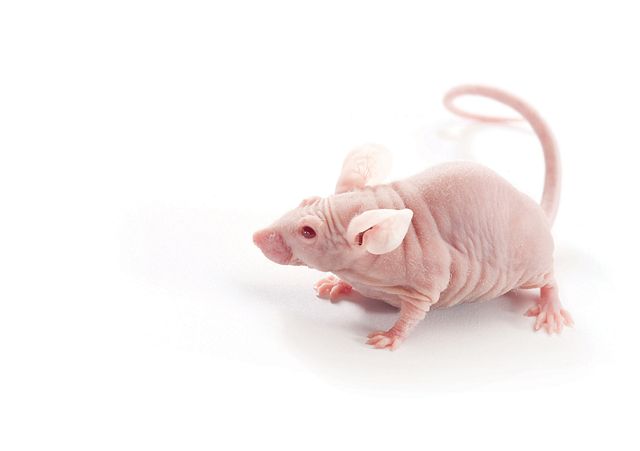
Which Immunodeficient Model is Right for Your Study?
Our global portfolio of high-quality immunodeficient mouse and rat models gives you the benefit of partnering with an industry leader offering an infrastructure capable of advancing your research both now and in the future. To help you identify the best immunodeficient mouse or rat model for your oncology research, we have animal models with various levels of immunodeficiency and phenotypic characteristics.
Humanized and Immunodeficient Model Resources
Leverage our resource collection, including major conference posters, white papers, and webinars delivering study data and insights to help you select the right humanized or immunodeficient model for your study. Download Now
Immunodeficient Mice and Rats
Degree of Immunodeficiency, Highest to Lowest
| Strain (NA) | Species | Mature T Cell- Deficient | Mature B Cell-Deficient | NK Cell-Deficient | Genetics | |
|---|---|---|---|---|---|---|
| NCG Plus Portfolio (Amenable to humanization) | Mouse |  | | | Coisogenic | |
| SRG | Rat | | | | Inbred | |
| NOD SCID | Mouse | | |  | Congenic | |
| NIH-III Nude | Mouse | | | | Outbred | |
| Fox Chase SCID® Beige | Mouse | | | | Congenic | |
| SCID Hairless Outbred (SHO®) | Mouse | | | Outbred | ||
| Fox Chase SCID® | Mouse | | | Congenic | ||
| NCI SCID/NCr | Mouse | | | Congenic | ||
| BALB/c Nude | Mouse | | Inbred | |||
| NU/NU Nude | Mouse | | Outbred | |||
| CD-1 Nude | Mouse | | Outbred | |||
| Athymic Nude | Mouse | | Outbred | |||
| RNU Nude Rat | Rat | | Outbred |
= deficient = impaired (somewhat deficient)
Immunodeficient Model Resources
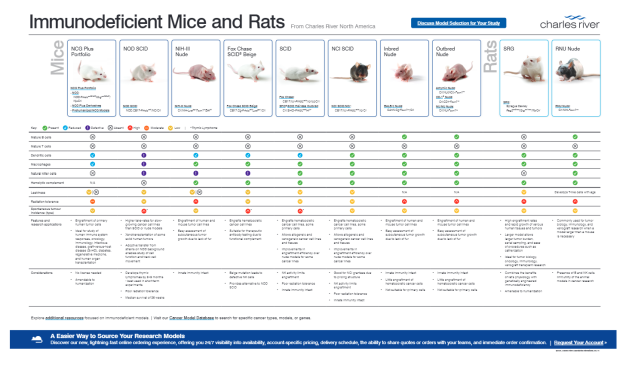
Immunodeficient Models Poster
This poster lists the major phenotypes of Charles River's immunodeficient mice and rats. It includes information on model features, degree of immunodeficiency, and gene functions. Download Poster
| Case Study | Surgery Model Utilizations in Oncology |
| Xenograft Data | We've compiled xenograft data on certain immunodeficient models to help expedite the model selection process. |
Frequently Asked Questions (FAQs) About Immunodeficient Mice and Rats
-
What are xenografts?
Xenografts are organ transplants or tissue grafts from a donor of a different species from the recipient. Immunodeficient mice are capable of engrafting cells and tissues from humans and other species, especially from cancer cells.
-
What are triple immunodeficient mice?
Triple immunodeficient mice are capable of hosting xenograft cells, tissue, and human immune system components, thus enabling studies of tumor biology and immune-oncology, infectious disease, graft-versus-host disease (GvHD), hematopoiesis, and tissue transplant studies. Our triple-immunodeficient mice are used for research in the fields of oncology, immunology, regenerative medicine, and infectious diseases.
-
What areas of research are best suited for immunodeficient mice?
Immunodeficient mice are used in research for cancer, immunology, stem cell, and infectious disease.
-
What are SCID mouse models? What areas of research can SCID mice be applied in?
SCID mice have a genetic autosomal recessive mutation that causes a severe combined immunodeficiency affecting both B and T lymphocytes. SCID models are best suited in biology studies of the immune system, but can also be applied to tumor growth studies and studies of normal and abnormal lymphocyte development and function.
-
What are nude mice? What areas of research can nude mice be applied in?
Nude mice have a genetic mutation that causes these strains to lack a normal immune system and thymus gland. The reduction of T cells causes these mice to have a repressed immune system. Nude mouse models are often utilized for tissue and tumor grafts in cancer research because they don’t have a rejection response.
