Approaches to Rare Disease Studies
Where to start your rare disease drug development? In the race for a cure, researchers and patient-centric foundations are attacking rare disease research from multiple angles and in parallel. With the goal of reducing drug development time, scientists are applying innovative technologies, assessing multiple modalities and leveraging lessons learned from various forums.

eBook: "Translational Strategies Accelerate Drug Discovery"
This eBook focuses on translational science and discovery partnerships that advance novel therapies through a collective momentum, leveraging efficiencies in drug discovery to accelerate nonclinical research and increase clinical success.
Download the eBook
Technologies for Rare Disease Studies
Platforms such as high-throughput screening (HTS), cell-based assays, and research models can be designed to mimic specific diseases using CRISPR and stem cells technology, providing more disease-relevant data for safety studies and translation to the clinic.
- Research Models
- Antisense Oligonucleotide Screening Services (ASO)
- CRISPR
- Stem Cells
- High-Throughput Screening
- High Content Imaging
- Cell-Based Assays
- Chemistry Services
- In Vivo Pharmacology Models
- CRADL® Rentable In Vivo Vivarium Space
- Safety Studies
We are proud to collaborate with Open Treatments Foundation to decentralize gene therapy for rare genetic diseases by empowering patient foundations.

Hear from Leading Researchers, Clinicians, and Patient Advocates how their collaboration lead to the development of Jacifusen, an ALS antisense therapy.
Watch the Collection
Modalities in Rare Disease Studies
The rare disease research pipeline is growing, fueled by technological advances in multiple modalities such as antisense oligonucleotide therapies.
- Small molecules
- Biologics
- Gene and cell therapy
- Antisense oligonucleotides (ASOs)
- siRNA/RNA interference therapeutics
Drug Development by Disease
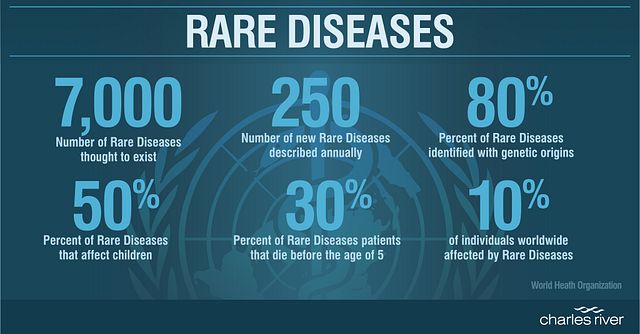
The World Health Organization has identified over 7,000 rare diseases and expects 250 more added to the list each year. That’s 1 in 10 of the population affected.
- Amyotrophic lateral sclerosis (ALS)
- Batten disease
- Duchenne muscular dystrophy (DMD)
- Usher III syndrome
- Huntington’s disease

The Disruptors: Conversations in Science
To pay homage to the most disruptive and visionary scientists leading the effort on the frontlines, Charles River is sharing stories about the state and direction of scientific research, discovery, and therapeutic development.
Meet the Disruptors
Frequently Asked Questions (FAQs) about Rare Disease Research
-
What classifies a disease as rare or orphan?
The World Health Organization classifies a disease as rare or orphan if there is a prevalence of 0.65% - 1.0% in the population. Many regions have their own definition. In the US, a disorder is classified as rare if it affects less than 200,000 people, in Europe when it affects less than 1 in 2,000.
-
Where can I find a list of rare diseases?
Databases can be found at National Organization for Rare Disorders. More resources can be found at Eurodis.
-
How many rare diseases have a treatment or cure?
According to the World Health Organization, only 5% of these diseases have a treatment. With innovative approaches such as gene and cell therapy, there is increasing hope that number will rise.
For more FAQs visit NIH Genetic and Rare Disease Information Center.